ERP Software in Bangalore: The Complete 2026 Buyer's Guide
Looking for ERP software in Bangalore that matches your budget, your industry and your growth plans? This guide explains what to look for, what it costs and how to launch without disruption.
What Is ERP Software and Why Does It Matter?
ERP software in Bangalore connects finance, inventory, production, sales, HR and purchasing inside one system. Instead of juggling spreadsheets and disconnected tools, every team works from the same live data.
The city hosts thousands of startups, exporters, engineering units and service firms. For them, a single source of truth is no longer a luxury. The right ERP software in Bangalore decides how quickly a business can quote, produce, invoice and collect payment.
Signs Your Business Is Ready for an ERP System
Many owners wait too long. If you recognise three or more of the signs below, an integrated ERP solution will likely pay for itself quickly.
- Teams keep separate Excel sheets for stock, sales and accounts, and the numbers rarely match
- Customers wait days for quotations or delivery updates because information sits with different people
- Month-end reports take a week to prepare and are outdated by the time they reach management
- Production is delayed by missing material, and nobody knows until the shop floor stops
- GST filing feels stressful because invoices, purchases and returns are reconciled by hand
- You plan to open another branch, plant or warehouse and need central control
Why Bangalore Businesses Are Switching to ERP
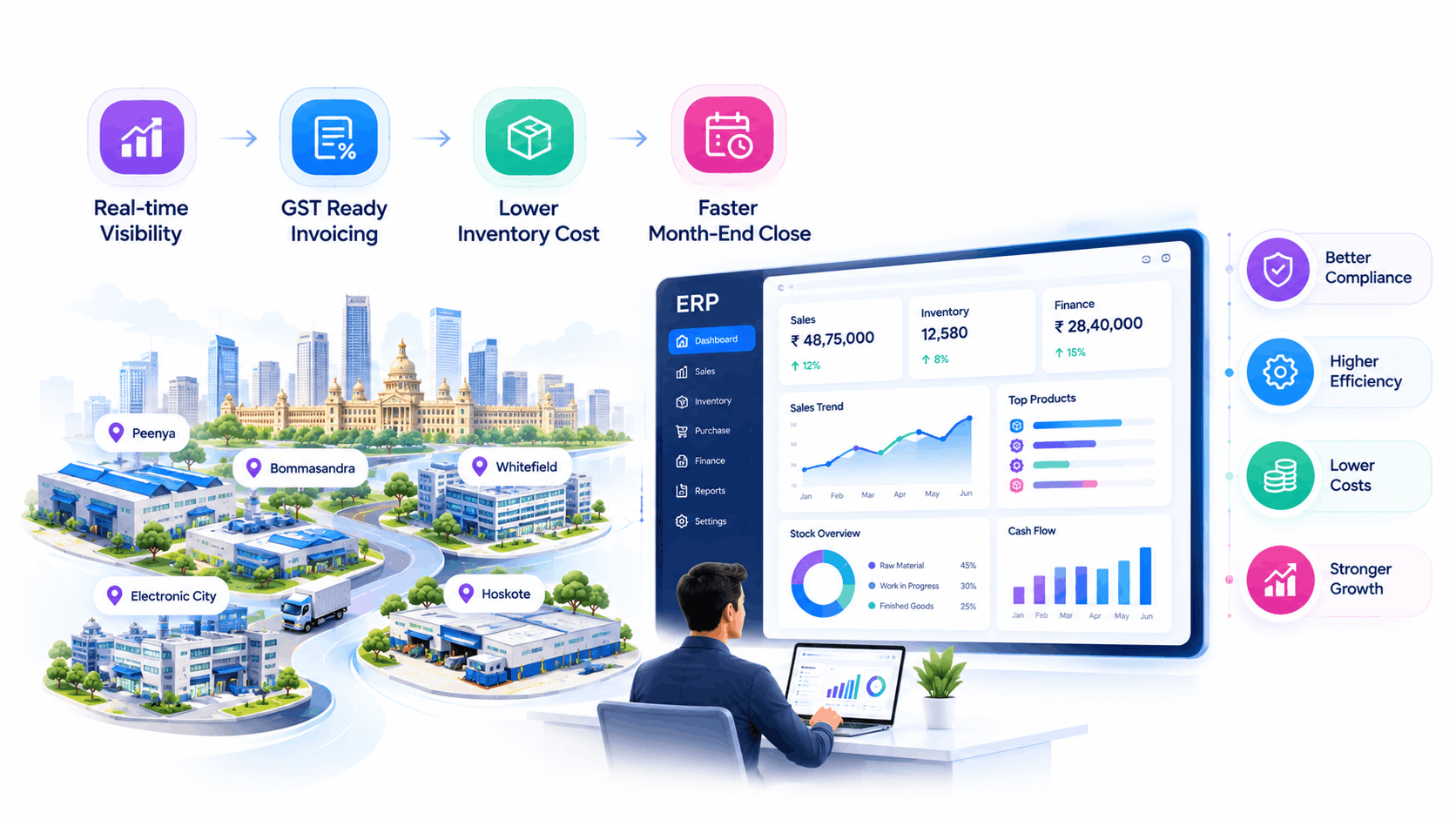
Bangalore is India's technology capital, yet its economy is far wider than IT. Peenya, Bommasandra, Electronic City, Whitefield and Hoskote are home to precision manufacturers, electronics assemblers, auto-component suppliers and export houses. All of them face rising material costs, tight delivery windows, compliance rules and a shortage of skilled staff.
Modern ERP software in Bangalore answers these pressures through automation. Here is what companies gain:
- Real-time visibility of stock, orders and cash flow on one dashboard
- GST-ready invoicing and e-way bill support that cut compliance errors
- Lower inventory cost because purchasing follows actual demand
- Faster month-end close with finance data updated automatically
Six Must-Have Modules in ERP Software
Every vendor claims to offer the best ERP software in Bangalore, so compare features, not slogans. These six modules form the backbone of dependable ERP software in Bangalore.
Inventory and Warehouse
Track batches, serial numbers and multi-location stock with barcode support and reorder alerts.
Production Planning
Manage bills of material, work orders and material requirement planning without guesswork.
Finance and GST
Automate ledgers, payables, receivables, tax returns and e-invoicing in one place.
Sales and CRM
Convert enquiries into quotations, orders and dispatches while tracking every customer touchpoint.
Purchase and Vendors
Compare supplier quotes, approve purchase orders and monitor delivery performance.
Reports and Analytics
See profit by product, plant or customer through live, drill-down reports.
Best ERP Software for Manufacturing in India: What Bangalore Factories Need
Factories need more than accounting. The best ERP software for manufacturing in India supports bills of material, shop-floor tracking, quality checks, subcontracting and multi-plant costing. Generic tools rarely handle these workflows, which is why manufacturers should test industry-specific ERP software in Bangalore with their own production data.
Manufacturing Capabilities That Make a Difference
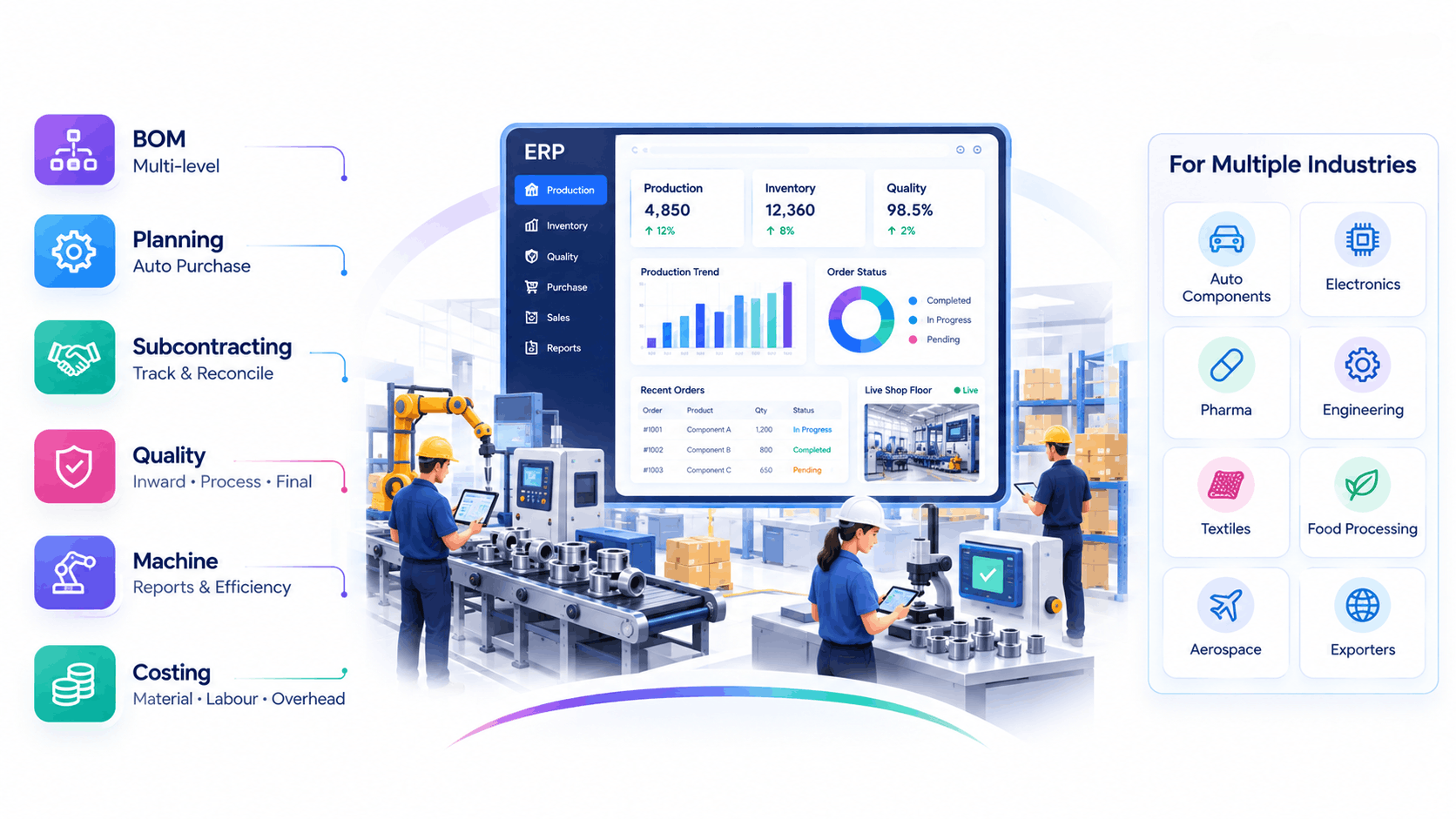
When you evaluate the best ERP software for manufacturing in India, look closely for these capabilities. They separate a true production system from a basic billing tool.
- Multi-level bill of material with version control for engineering changes
- Material requirement planning that raises purchase requests automatically
- Job-work and subcontracting tracking with challan and stock reconciliation
- Quality control checkpoints at inward, in-process and final inspection
- Machine and shift reports to spot idle time, scrap and rework
- Accurate product costing covering material, labour and overheads
ERP software in Bangalore also serves many other sectors. Strong systems adapt to each industry's terminology, tax rules and reporting needs:
Cloud vs On-Premise ERP: A Quick Comparison
Deployment is the first big decision when buying ERP software in Bangalore. The table below summarises the trade-offs.
| Factor | Cloud ERP | On-Premise ERP |
|---|---|---|
| Upfront cost | Low, subscription based | High, licence plus servers |
| Go-live speed | Weeks | Months |
| Updates | Automatic | Manual, planned downtime |
| Remote access | Anywhere, any device | Limited, needs VPN |
| Best for | Growing SMEs, multi-branch firms | Highly customised, offline plants |
How to Choose the Right ERP Partner in 6 Steps
A clear process keeps your search for ERP software in Bangalore objective and stress-free.
- Define your goals. List the problems to solve, such as stock mismatches, delayed billing or poor production visibility.
- Shortlist vendors. Prefer providers with proven Indian implementations and local support teams.
- Demand a live demo. Ask them to run your real process, not a polished sample.
- Check integrations. Confirm links to GST portals, banks, payment gateways and shop-floor devices.
- Test scalability. Your ERP software in Bangalore should handle more users, plants and products next year.
- Compare total cost. Include licences, training, customisation and annual support.
Five Common Mistakes to Avoid
Even a strong ERP system fails when the project is handled poorly. Avoid these traps and your rollout will run far more smoothly.
- Choosing on price alone. The cheapest quotation often leaves out training, support and customisation.
- Skipping user involvement. Storekeepers, accountants and supervisors must help design the workflows they will use daily.
- Migrating dirty data. Duplicate items, wrong opening balances and old customer records should be cleaned before import.
- Customising too much. Heavy changes slow upgrades. Use standard features first and customise only where it truly adds value.
- Ignoring change management. Staff need training, patience and a clear reason why the new system helps them.
A Realistic 90-Day Implementation Roadmap
Most projects follow four phases. First comes discovery and data cleanup in weeks one to three. Next is configuration and integration, followed by user training and a pilot run. Finally, the full go-live is supported by hands-on assistance. Good planning keeps ERP software in Bangalore projects on schedule and within budget.
During the pilot, run the old and new processes side by side for one or two weeks. This parallel run exposes gaps early, builds staff confidence and lets managers compare reports before the old method is retired. After go-live, schedule monthly reviews to measure stock accuracy, order cycle time and billing speed so that the improvements stay visible to leadership.
Why Work with a Digital Transformation Company in India
Software alone does not transform a business. A digital transformation company in India studies your workflows, redesigns weak processes and then configures the ERP to match. That approach prevents the common mistake of forcing people to adapt to a rigid tool.
Innoverse360 is a digital transformation company in India that helps manufacturers and growing businesses implement ERP software in Bangalore and other industrial hubs. From requirement mapping to training and post-launch support, one team stays accountable for results.
Whether you run a single plant or several branches, the best ERP software for manufacturing in India is only as good as its implementation team. Look for a partner who offers process consulting, data migration, user training and long-term support under one roof, and who is willing to share references from similar businesses.
What Does ERP Cost and Return?
Small businesses often start with per-user cloud plans, while larger factories invest in tailored deployments. Many companies report payback within one to two years through lower stock, fewer errors and faster billing. Ask every vendor for a written quotation, so that ERP software in Bangalore never brings hidden charges.
Beyond the licence fee, budget for data migration, staff training, hardware upgrades if needed and yearly support. Measure success with simple numbers: stock accuracy, on-time delivery, days to collect payment and hours saved on reports. When leadership can see these metrics improving every month, the investment is easy to justify, and teams stay motivated to use the new system properly instead of returning to old spreadsheets.
Ready to Choose ERP Software in Bangalore?
Talk to an Innoverse360 expert today and see a demo built around your business.
Frequently Asked Questions
Which ERP software in Bangalore suits small businesses?
Cloud-based systems with modular pricing suit small firms best. Choose one that starts with core modules and adds features as you grow.
How long does implementation take?
Most projects take 60 to 120 days, depending on the number of users, plants and data to migrate.
Is cloud ERP secure?
Yes, when the provider uses encryption, role-based access and daily backups. Ask for these safeguards in writing.
Does ERP software in Bangalore support GST and e-invoicing?
Reputable Indian systems include GST returns, e-invoicing and e-way bill generation as standard features.
Can ERP connect with my existing software and machines?
Yes. Most modern platforms offer APIs and ready connectors for banking, e-commerce, CRM, biometric attendance and shop-floor devices, so you keep the tools that already work.
What data should I prepare before moving to ERP?
Collect item masters, customer and vendor lists, opening stock, pending orders and ledger balances. Clean data before import saves weeks during rollout.