How IoT is Powering Smart Manufacturing in IndiaIoT in manufacturing India: from connected machines to confident decisions
IoT in manufacturing India is turning ordinary machines into talking assets. Sensors now tell plant managers when a bearing will fail, which batch drifts out of tolerance and where energy is wasted. Read on to see how factories across the country are using connected data to cut downtime, reduce waste, improve safety and win bigger orders. Whether you run a small workshop or a large multi-plant group, the steps below show you how to begin.
What Does IoT in Manufacturing India Really Mean?
The Internet of Things connects machines, tools, vehicles and even workers' wearables to a network that collects data around the clock. In a factory, that means a motor can report its own heat, a press can count every stroke and a forklift can share its position. When this stream reaches software that understands it, the plant stops reacting to problems and starts preventing them.
IoT in manufacturing India is no longer a pilot project reserved for global giants. Mid-sized pump makers in Coimbatore, garment units in Tirupur, auto-component suppliers in Chennai and pharma plants in Hyderabad are all adding sensors to existing equipment. The appeal is simple: you do not need to replace old machines. You attach low-cost sensors and gateways, then let the data show you where money leaks away.
That is why business owners who once asked "is it worth it?" now ask "where do we start?" This guide answers that question in plain language, with practical examples from Indian shop floors, simple steps you can follow and honest advice on common mistakes to avoid.
Why IoT in Manufacturing India Is Growing So Fast
Several forces have arrived together, and they make this the right moment for IoT in manufacturing India to move from experiment to everyday tool.
Policy momentum
Make in India, production linked incentives and the push for self-reliant supply chains reward factories that deliver consistent quality at scale. Connected data is the proof buyers want to see.
Cheaper hardware
Industrial sensors, gateways and edge devices cost a fraction of what they did a decade ago. A single machine can now be monitored for far less than one unplanned stoppage costs.
Better connectivity
Wider 4G and 5G coverage, plus reliable industrial Wi-Fi and low-power networks, let data travel from a remote plant to a cloud dashboard in seconds.
Export pressure
Global customers demand traceability, energy reporting and fast delivery. Smart factories can document every batch, which helps Indian exporters win and keep contracts.
Skilled workforce
India's engineers and technicians adapt quickly to new tools. Training a team to read a live dashboard is far easier than most owners expect.
Rising costs
Power tariffs, raw material swings and labour shortages squeeze margins. IoT in manufacturing India helps recover efficiency without adding headcount.
How IoT in Manufacturing India Works on the Shop Floor
A smart manufacturing setup has four simple layers. Understanding them helps you plan a project without getting lost in jargon. The illustration below shows how data moves from a machine to a manager's phone.
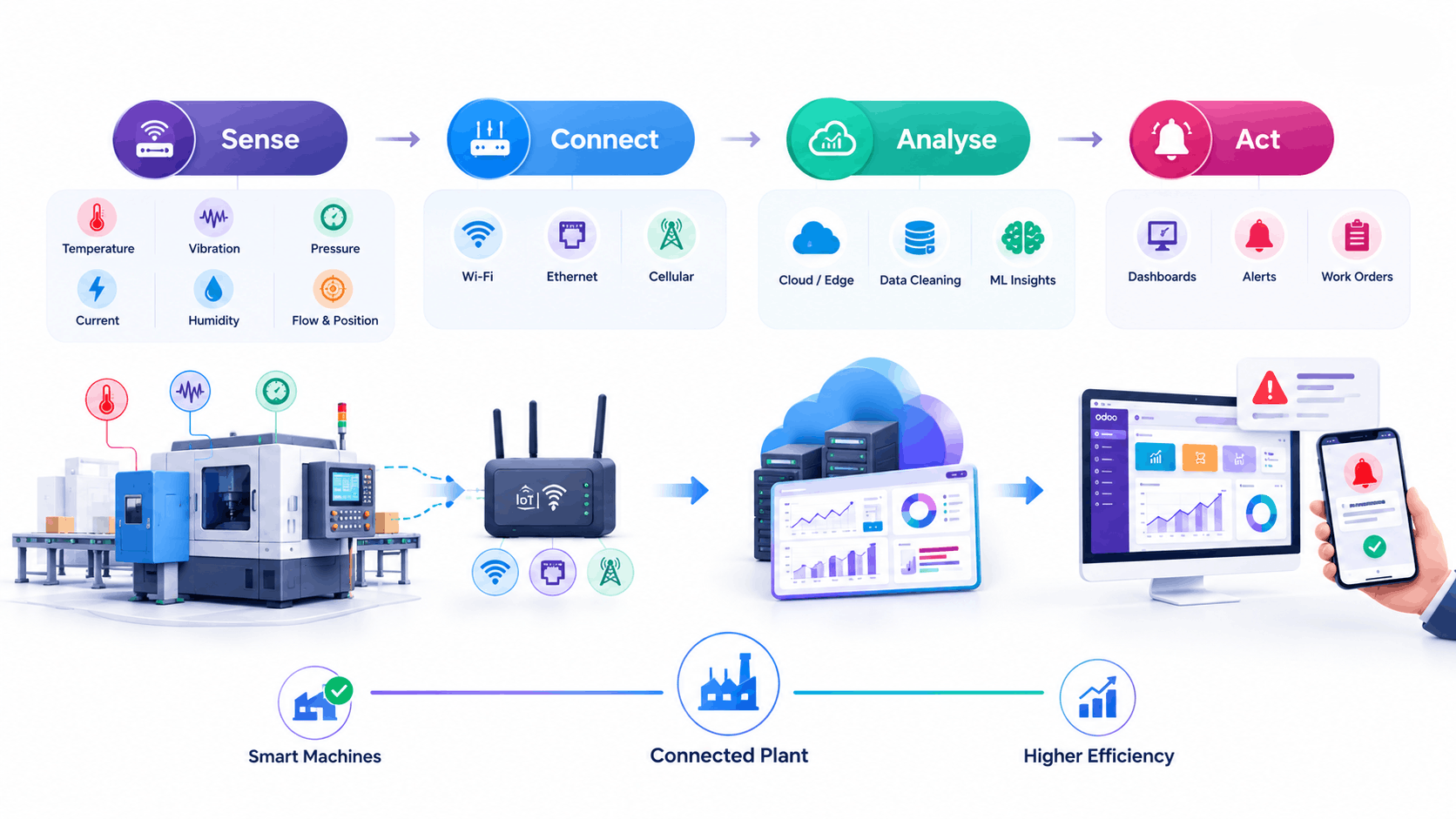
- SenseSensors measure temperature, vibration, pressure, current, humidity, flow and position on every critical asset.
- ConnectAn IoT gateway collects readings from older machines and modern controllers, then sends them securely over Wi-Fi, Ethernet or cellular networks.
- AnalyseCloud or edge software cleans the data, compares it with normal patterns and uses machine learning to spot trouble early.
- ActDashboards, alerts and automated work orders reach the right person immediately, so the fix happens before the line stops.
This flow is the backbone of IoT in manufacturing India, and it works equally well for a ten-machine workshop and a multi-plant group.
Top Use Cases of IoT in Manufacturing India
Predictive maintenance
Vibration and heat patterns reveal worn bearings and failing motors days ahead. Maintenance teams schedule repairs during planned breaks instead of fighting emergencies.
Quality monitoring
Real-time process data flags drift before parts go out of tolerance. That means less scrap, fewer rejections and happier customers.
Asset and inventory tracking
Tags and scanners show where tools, moulds, pallets and finished goods are, ending the daily hunt for missing items.
Energy management
Smart meters link power use to each machine and shift. Owners find idle running, peak demand spikes and chances to lower electricity bills.
Worker safety
Gas, temperature and proximity sensors warn teams about hazards, while wearables can raise an alert if someone is in danger.
Supply chain visibility
GPS and condition sensors track raw material and shipments, so planners know what arrives, when and in what state.
Where IoT in Manufacturing India Delivers Results by Sector
Automotive and auto components: Chennai, Pune and Gurugram plants use connected torque tools, press monitors and traceability tags to meet tight OEM standards. Every part carries a digital history that auditors can verify in minutes.
Textiles and garments: In Tirupur and Erode, sensors on knitting and dyeing machines track output, water use and downtime by shift. Managers compare lines fairly and fix bottlenecks quickly.
Pumps, motors and engineering: Coimbatore's engineering clusters use test-bench data and machine monitoring to shorten delivery cycles and prove performance to industrial buyers.
Pharma and food processing: Temperature, humidity and batch records are logged automatically, which simplifies compliance and protects product quality.
Across all these sectors, IoT in manufacturing India gives owners the same advantage: facts instead of guesses. Shift supervisors see the same numbers as the managing director, so meetings become shorter, decisions become faster and every improvement can be measured against a clear starting point.
Challenges of IoT in Manufacturing India and How to Beat Them
Legacy machines
Many plants run equipment that is decades old. Retrofit sensors and protocol converters make these machines smart without costly replacement.
Data security
Connected systems need encrypted communication, role-based access and network segmentation to keep production data safe from cyber threats.
Skills and adoption
Technology fails when people ignore it. Short training sessions and simple dashboards help operators trust and use the numbers.
Unclear return on investment
Start with one painful problem, such as a frequently failing machine, and measure savings. Early wins fund the next phase of IoT in manufacturing India projects.
Your Roadmap to Start IoT in Manufacturing India
A successful rollout is gradual and practical. Follow this order to keep risk low and results visible.
- Pick one problemChoose a bottleneck machine, a quality issue or a high energy line and define the number you want to improve.
- Audit your equipmentList machine types, controllers and available data points, then decide which can connect directly and which need retrofit sensors.
- Run a focused pilotConnect five to ten assets, build a live dashboard and track results for a few weeks.
- Integrate with ERPLink IoT data to production planning, inventory and maintenance modules so insights trigger real actions automatically.
- Scale with confidenceRoll out to more lines and plants, using lessons from the pilot to standardise sensors, alerts and reports.
Why Innoverse 360 Is the Best Digital Transformation Company in India for Smart Factories
Technology alone does not transform a factory. The right partner connects sensors, software and people into one working system. Innoverse 360 is a Chennai-based team that helps manufacturers move from scattered spreadsheets to connected, data-driven operations. Many owners searching for the best digital transformation company in india look for three things: honest planning, proven ERP expertise and support after go-live. That is exactly where Innoverse 360 focuses.
From ERP implementation to custom dashboards and workflow automation, the team ties IoT in manufacturing India projects to business goals such as higher uptime, lower scrap and faster deliveries. If you are comparing the best digital transformation company in india for your plant, ask for a pilot plan, a clear timeline and measurable targets. A partner confident in results will happily share them.
Choosing the best digital transformation company in india also means choosing someone who understands local realities: power fluctuations, mixed machine ages, multilingual shop floors and tight budgets. Innoverse 360 builds solutions around those realities, so your team adopts them quickly. Many manufacturers call it the best digital transformation company in india because it keeps technology simple and results visible.
Frequently Asked Questions About IoT in Manufacturing India
Is IoT in manufacturing India only for large factories?
No. Small and medium units benefit greatly because even a few connected machines can reveal downtime and energy waste. Start small and expand as savings appear.
Can old machines be connected to IoT systems?
Yes. Retrofit sensors and gateways read signals from older equipment, so you can modernise without replacing machinery.
How long does a pilot take?
A focused pilot on a handful of machines usually runs for a few weeks, long enough to collect meaningful data and prove the value of IoT in manufacturing India for your plant.
Does IoT replace workers?
It supports them. Operators and technicians get early warnings and clear data, so they spend less time firefighting and more time improving the process.
Ready to Build a Smart Factory?
Talk to the Innoverse 360 team about IoT in manufacturing India and get a clear, practical plan for your plant. Call, message us on WhatsApp or explore innoverse360.com today.