Digital Transformation in India: The 2026 Manufacturing Playbook
Digital transformation in India is no longer a future plan — it's the reason some factories are winning bigger orders while others are stuck reconciling spreadsheets at month-end. Across Erode, Coimbatore, and manufacturing hubs nationwide, plant owners are discovering that this digital shift isn't about replacing people with machines — it's about giving the people already on the floor better information to work with. This guide breaks down exactly how this change works for manufacturers, and how to choose the best ERP software for manufacturing in India to lead it.
What Digital Transformation in India Really Means for Factories
At its core, digital transformation in India means replacing manual, paper-based shop-floor processes with connected digital systems — ERP, cloud computing, IoT sensors, and real-time data dashboards. For manufacturers, the move to digital systems touches every stage of the business: raw material procurement, production planning, quality checks, and final dispatch.
It isn't just about buying new software. Genuine progress here changes how decisions get made on the floor — swapping gut-feel and end-of-day reports for live, accurate data that plant managers and owners can act on the same hour a problem appears.
Why Digital Transformation in India Is Accelerating Right Now
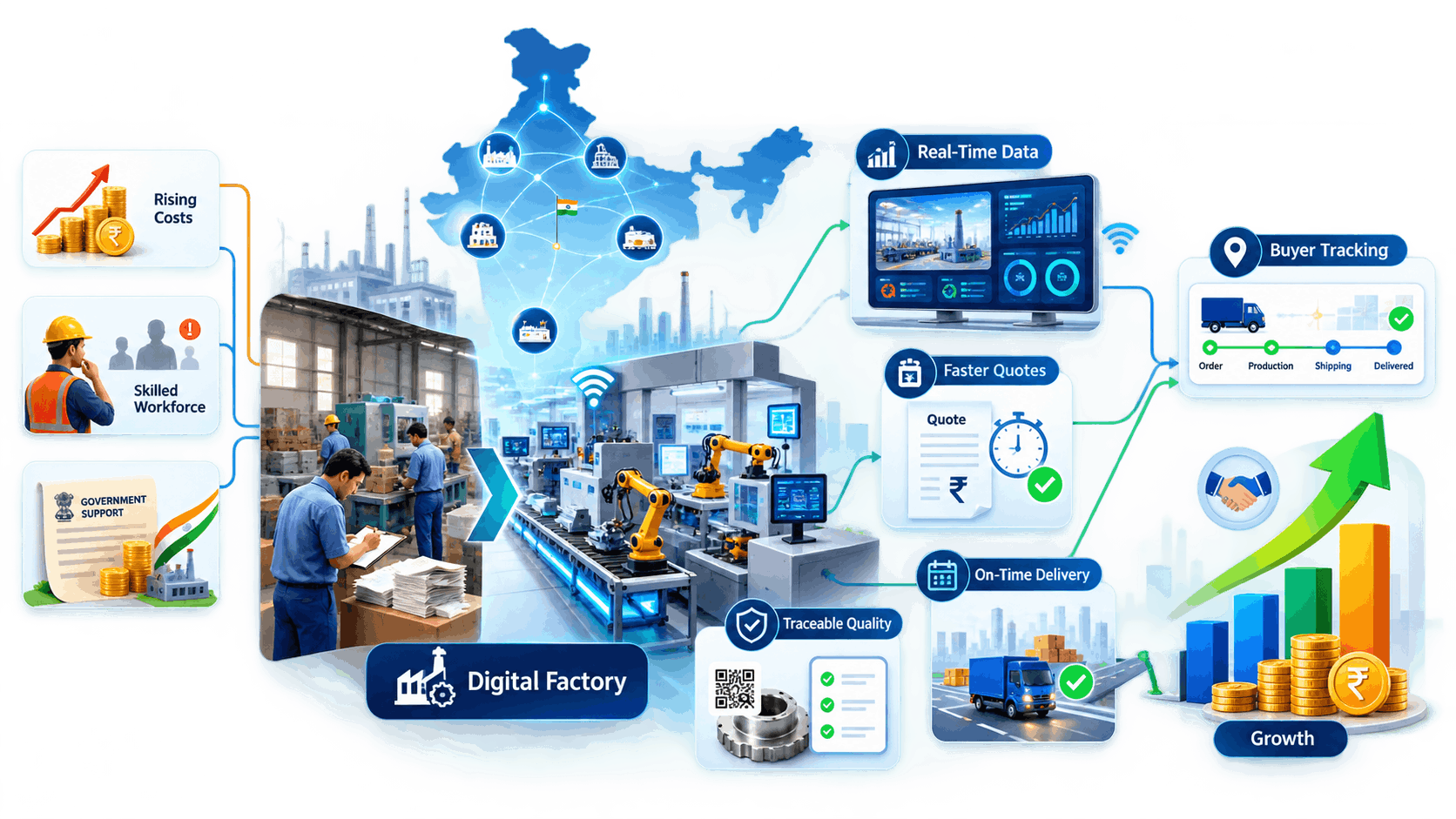
Several forces are pushing the transformation process forward this year: rising input and labour costs, a shrinking pool of skilled shop-floor supervisors, government incentives under Make in India and PLI-linked schemes, and buyers who now expect real-time order visibility before they sign a contract.
Manufacturers who delay this shift are already losing bids to competitors who can quote faster, confirm delivery dates with confidence, and back up quality claims with traceable production data instead of a paper logbook.
Manufacturing Before and After Digital Transformation in India
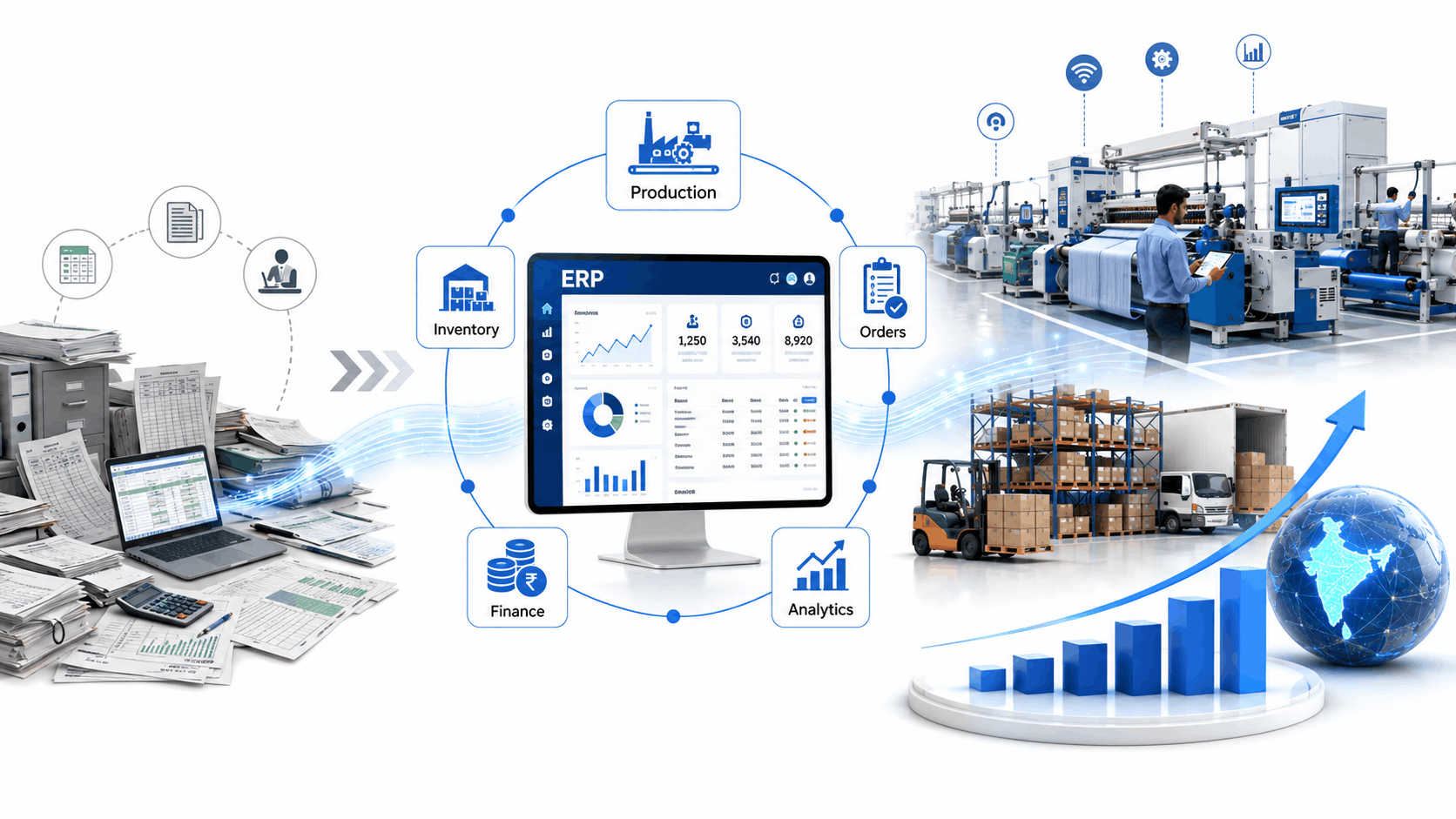
It helps to see the contrast plainly. Before the shift to digital manufacturing, a typical mid-size factory tracks stock on paper registers, confirms delivery dates by asking the supervisor to walk the floor, and finds out about a quality issue only after a customer complains. Costing is estimated at month-end, and the owner often makes purchasing decisions based on memory rather than data.
After this modernization, the same factory sees live stock levels from a phone, gets automatic alerts the moment a machine falls behind schedule, and can quote a new customer with confidence because job-costing is calculated in real time, not reconstructed after the fact. This shift alone is why so many owners describe the transition as the single biggest operational upgrade they've made in a decade.
5 Pillars of Digital Transformation in India for Manufacturers
Every successful digital-shift project we've studied follows the same underlying structure. Miss one pillar, and the rest struggle to deliver a return.
Cloud ERP & Data Unification
The foundation of this change starts with a single source of truth — a modern ERP that connects finance, inventory, procurement, and production planning in one place, accessible from any location.
Shop-Floor Automation & IoT
Sensors on machines feed live output, downtime, and quality data straight into your ERP, removing the manual entry step that slows down most rollouts of this kind.
AI-Powered Demand Forecasting
Instead of ordering raw material on instinct, forecasting tools built into modern ERP suites use historical order data to predict what to stock — a core reason mid-size factories pursue this shift toward digital operations.
Cybersecurity & Data Governance
As factories go digital, protecting customer drawings, pricing, and production data becomes non-negotiable — role-based access and audit trails are standard in any serious plan for this process.
Change Management & Workforce Training
Technology is the easy part. The manufacturers who get real value from this shift are the ones who invest in training supervisors and operators to trust and use the new system daily.
Choosing the Best ERP Software for Manufacturing in India
Not every ERP is built for how Indian factories actually run. The best ERP software for manufacturing in India needs to handle GST compliance, multi-location inventory, job-costing, and machine-level integration out of the box — this single decision sets the pace for your entire transformation journey.
Compare ERP Options With Us- GST & Indian statutory compliance built-in
- Multi-plant, multi-warehouse inventory sync
- Job-costing & batch-wise profitability
- Shop-floor / machine data integration
- Mobile access for supervisors & owners
- Transparent, predictable licensing cost
A Realistic Implementation Timeline
One reason owners hesitate on the shift to digital manufacturing is uncertainty about how long the disruption will last. In practice, a well-scoped rollout follows a predictable rhythm rather than dragging on indefinitely.
Process Mapping & ERP Selection
Document current workflows and shortlist the best ERP software for manufacturing in India against your specific plant setup, not a generic feature list.
Core Configuration & Data Migration
Inventory, BOMs, vendor and customer records move into the new system — the most labour-intensive stage of any modernization project.
Team Training & Parallel Run
Supervisors and operators run the new system alongside the old process for a few weeks, building confidence before the full switch.
Automation & Forecasting Layer
Once the ERP core is stable, machine-level IoT and demand forecasting are added — the phase where the transition starts compounding in value.
Common Roadblocks Slowing Digital Transformation in India
Owners assume this digital shift requires a large upfront budget, when phased ERP rollouts can start with core modules and expand as ROI proves out.
Long-serving staff are used to registers and manual logs; without proper onboarding, this change stalls at the adoption stage, not the technology stage.
Generic, foreign-built ERPs often miss Indian compliance needs entirely — another reason the search for the best ERP software for manufacturing in India matters more than the brand name attached to it.
Projects without a single internal champion driving the move to digital systems tend to lose momentum after the first two months.
None of these roadblocks are unusual, and none of them are reasons to postpone this shift toward digital operations indefinitely. Most factories that succeed treat the first roll-out as a phased pilot on one production line or department, prove the value there, then expand — rather than trying to digitise the entire plant on day one.
Industries Leading Digital Transformation in India
While every manufacturing segment benefits, some sectors are moving faster on the transformation process than others, largely because their margins and compliance needs make manual processes especially costly.
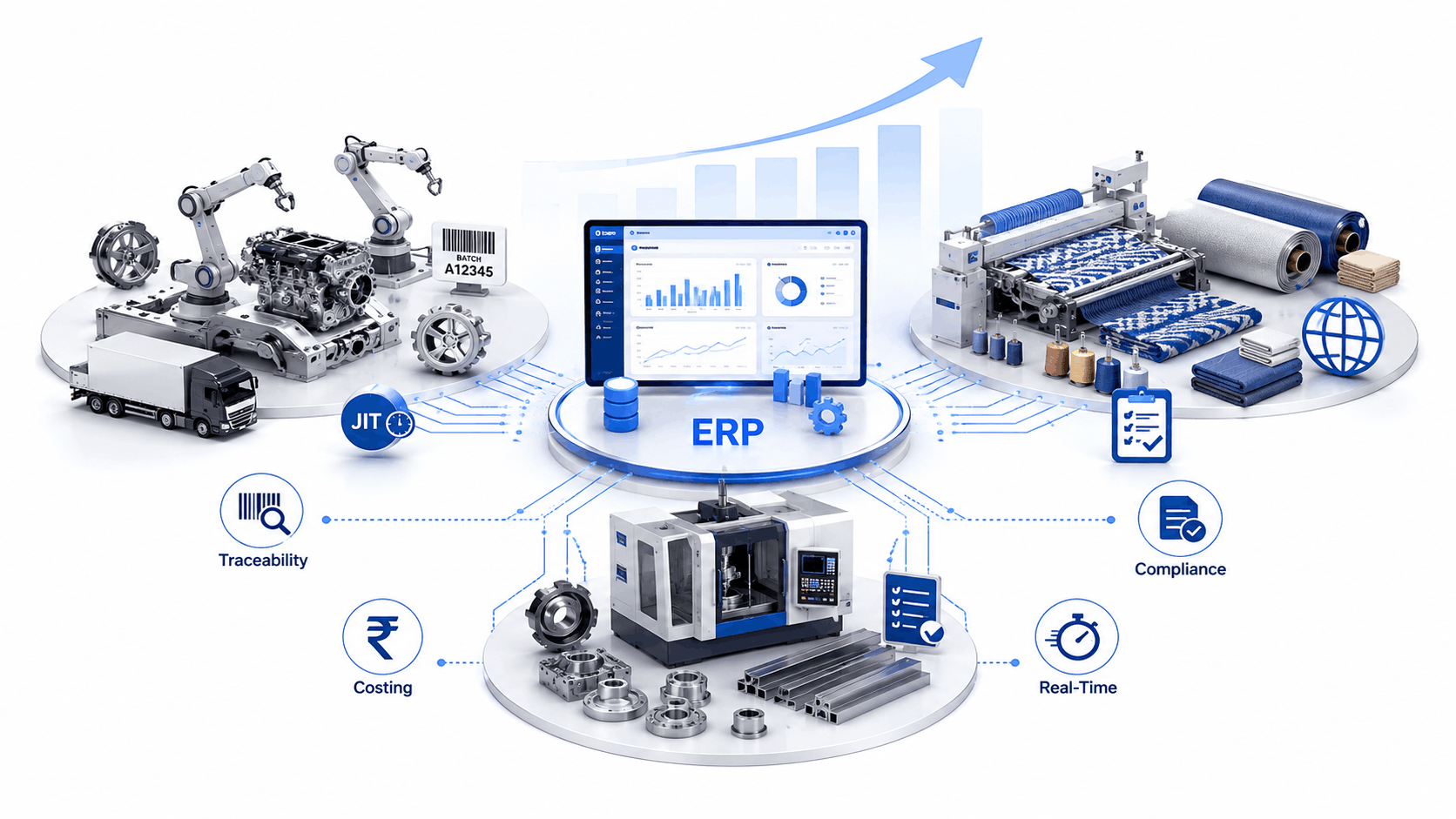
How Innoverse 360 Supports Digital Transformation in India
Innoverse 360 works with manufacturers across India to plan and execute transition initiatives — from ERP selection to shop-floor system integration.
Digital Transformation in India: Frequently Asked Questions
What factors affect the investment needed for digital transformation in India?
The investment required for this digital shift depends mainly on ERP scope, number of users, and how many shop-floor integrations are needed. Most manufacturers start with a phased rollout — core ERP first, automation and forecasting layered in later — so the initial commitment stays manageable.
How long does digital transformation in India take for a mid-size factory?
A structured rollout for this change typically takes 8 to 16 weeks for core ERP go-live, with automation and IoT layers added over the following two quarters.
Is the best ERP software for manufacturing in India cloud-based or on-premise?
Most manufacturers now choose cloud-based systems when evaluating the best ERP software for manufacturing in India, since it lowers upfront IT cost and gives multi-location visibility from day one.
Where should a factory start its digital transformation in India journey?
Start with ERP and inventory visibility before adding automation — this order keeps the move to digital systems manageable and gives you clean data to run AI or IoT projects on later.
The manufacturers getting the most out of this shift toward digital operations right now aren't necessarily the biggest ones — they're the ones who picked the right first step, got their team on board, and let the ERP foundation prove itself before layering on automation. That order matters more than the size of the budget behind it.
Ready to Start Your Digital Transformation in India?
Talk to Innoverse 360 about the right ERP fit, a realistic rollout timeline, and a plan built around how your factory actually runs — not a generic template.