Digital Transformation for Trading and Distribution Businesses
Distributors and traders run on thin margins, fast stock movement and constant customer pressure. This guide explains how digital transformation distribution companies can connect sales, stock, finance and delivery into one clear and reliable system.
Why Digital Transformation Distribution Companies Cannot Wait
Trading and distribution looks simple from the outside: buy in bulk, store, sell and deliver. Inside, it is a daily balancing act between thousands of SKUs, dozens of suppliers, hundreds of retailers and strict credit cycles. Spreadsheets, paper challans and phone calls worked when volumes were small. Today they create delays, errors and blind spots. This is why digital transformation distribution companies adopt early gain a visible edge over slower competitors.
Customers now expect instant price quotes, accurate stock availability, online ordering and correct GST invoices. Suppliers expect faster reconciliation and on-time payments. Banks and investors expect clean, reliable data. A business that cannot answer these demands quickly loses orders to a rival who can. Digital transformation distribution companies rely on is the practical way to meet every one of these expectations without hiring an army of data-entry staff.
The good news is that transformation does not mean replacing everything overnight. It means choosing the right systems, connecting them properly and training your people to use them with confidence.
What Digital Transformation Really Means for Distributors
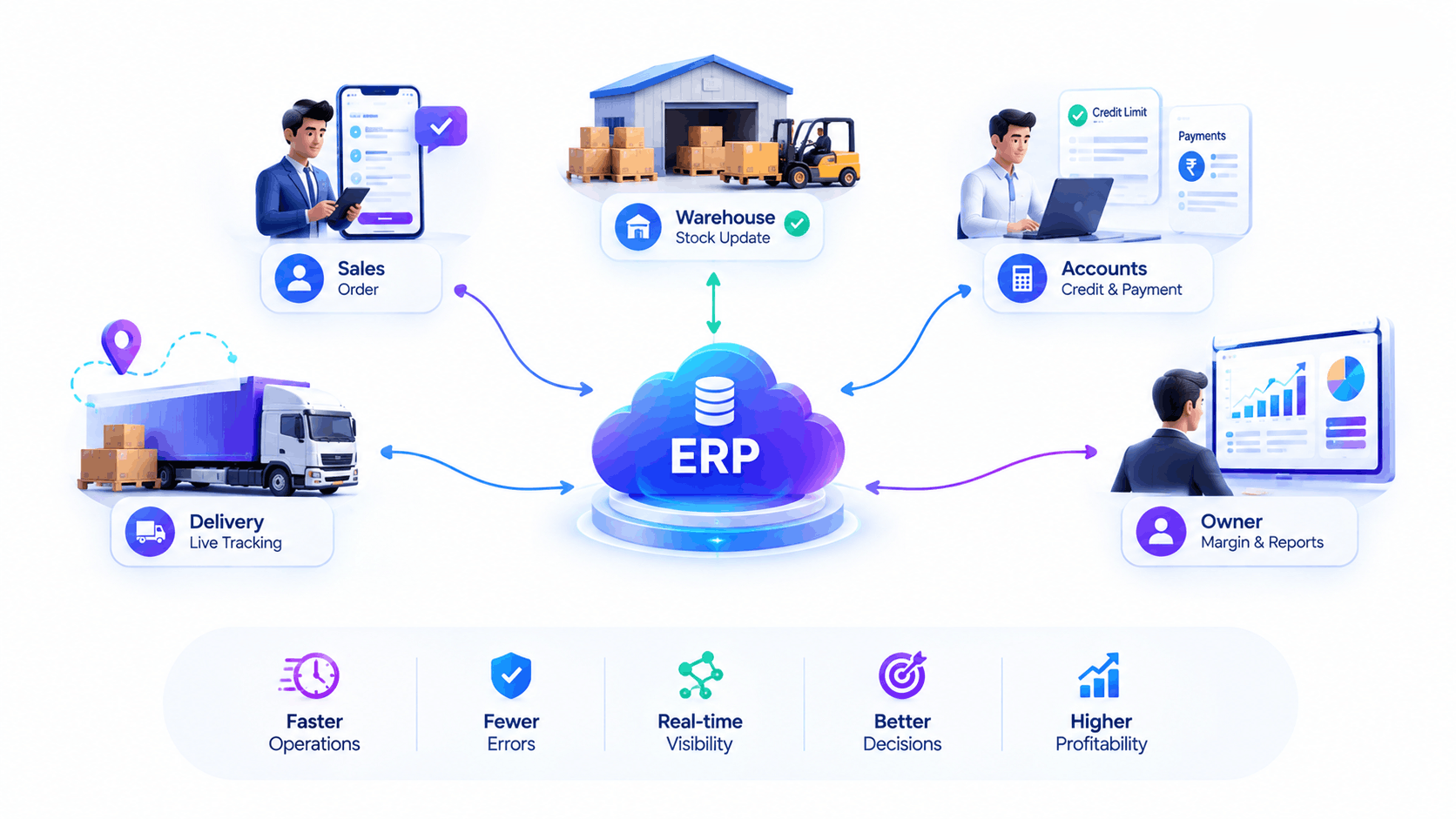
Many owners assume digital transformation means buying software. In reality, it is a change in how the business captures, shares and uses information. For digital transformation distribution companies, the goal is simple: every order, stock movement, payment and delivery should be recorded once and visible to everyone who needs it, instantly.
When a salesman books an order on a mobile app, the warehouse sees it immediately, accounts see the credit limit, and the owner sees the margin. Nobody re-types anything. That single flow of data removes mistakes, saves hours every day and gives management the confidence to take faster decisions.
Common Problems Holding Distribution Businesses Back
Before choosing technology, it helps to name the real problems. Most owners recognise several of these in their own operations.
Stock Mismatch
Physical stock never matches the books, causing stock-outs of fast movers and dead inventory of slow ones.
Delayed Collections
Outstanding payments are tracked in notebooks, so reminders are late and credit limits are ignored.
Manual Billing Errors
Re-typing orders into billing software leads to wrong rates, wrong quantities and disputed invoices.
No Field Visibility
Owners cannot see what salesmen are doing, which retailers are ordering or which beats are underperforming.
Scheme Confusion
Manufacturer schemes and discounts are applied by hand, so claims are missed and margins leak quietly.
Late Reporting
Monthly numbers arrive weeks later, so decisions rely on guesswork instead of live information.
Core Technologies Every Modern Distributor Needs
Successful digital transformation distribution companies usually build on six connected capabilities. You do not need all of them on day one, but your plan should leave room for each.
ERP Software
A central system for purchase, sales, inventory, accounts and GST compliance, with one version of the truth for every department.
Distributor Management System
Handles secondary sales, retailer ledgers, schemes, claims and route planning so supply to the last mile stays organised.
Sales Force Automation
Mobile apps let salesmen check stock, share catalogues, capture orders and record visits with location proof.
Warehouse Management
Barcode scanning, bin locations and batch or expiry tracking make picking faster and audits painless.
B2B Ordering Portal
Retailers place repeat orders themselves, view invoices and pay online, which frees your team from routine calls.
Analytics Dashboards
Live dashboards show margins, ageing, top customers and slow stock so you act before problems grow.
A Practical Roadmap for Digital Transformation Distribution Companies
Random software purchases rarely work. A structured roadmap keeps the project on budget and keeps your team on board. Here is a simple five-step path that digital transformation distribution companies can follow.
Audit Current Processes
Map how an order travels from enquiry to payment. Note every manual step, delay and repeated entry.
Set Clear Goals
Define measurable targets such as lower stock variance, faster billing, reduced outstanding days and better order accuracy.
Choose and Integrate
Select systems that fit your trade, then connect them with accounting, GST portals and logistics partners.
Train and Pilot
Start with one branch or one product line, train users properly and fix issues before wider rollout.
Measure and Improve
Review dashboards monthly, compare against your goals and keep refining processes as the business grows.
Business Benefits You Can Expect
When executed well, digital transformation distribution companies invest in delivers benefits that show up directly in profit and peace of mind.
Higher Margins
Accurate costing, scheme tracking and smarter purchasing reduce hidden leakage.
Faster Cash Flow
Automated reminders and credit controls shorten collection cycles.
Lower Errors
Single-entry data means fewer wrong invoices and fewer disputes.
Happier Retailers
Quick quotes, correct deliveries and easy reordering build long-term loyalty.
Easier Compliance
GST returns, e-invoicing and e-way bills flow directly from clean records.
Scalable Growth
New branches, brands and territories can be added without chaos.
These gains compound over time. Faster billing improves collections, better collections free up working capital, and that capital can be used to stock more profitable brands. Owners also gain time, because they no longer chase information across phone calls and notebooks. Instead, they open one dashboard, see the whole business clearly and spend their energy on growth, supplier negotiations and customer relationships.
How to Choose the Best Digital Transformation Company in India
The technology is only half the story. The partner you pick decides whether the project succeeds. If you are searching for the best digital transformation company in India, look beyond the demo and judge them on these points.
First, look for real experience in trading and distribution, not just generic software development. A partner who understands beats, schemes, credit cycles and GST will configure the system correctly the first time. Second, check whether they offer end-to-end support, including consulting, implementation, integration, training and long-term maintenance.
Third, ask about customisation. Every distributor has a unique way of working, and the best digital transformation company in India will adapt the software to your process instead of forcing you to change everything. Finally, verify post-launch support, response times and references from similar clients.
Innoverse 360 is a Chennai-based ERP and digital transformation company that helps businesses modernise operations with practical, well-supported solutions. Many owners shortlist them when they want the best digital transformation company in India for a distribution project. You can explore their services at Innoverse 360 and request a consultation. Choosing the best digital transformation company in India early saves months of rework later.
Mistakes Digital Transformation Distribution Companies Should Avoid
Even well-funded projects fail when basic mistakes are repeated. Knowing them in advance helps digital transformation distribution companies protect their budget, their staff morale and their customer relationships.
Buying Before Planning
Choosing software from a flashy demo, without mapping your processes, leads to expensive customisation and unhappy users.
Ignoring Data Quality
Importing messy item masters, duplicate customers and wrong opening balances carries old problems into the new system. Clean your data first.
Skipping Staff Training
Salesmen, storekeepers and accountants need role-based training. Without it, people drift back to paper and phone calls within weeks.
Trying Everything at Once
A big-bang launch overloads the team. Phase the rollout by branch or module so every stage is stable before the next one begins.
The most successful digital transformation distribution companies treat technology as a business project owned by management, not an IT task left to one person. They hold weekly review meetings, celebrate early wins and keep improving after go-live. Over time, digital transformation distribution companies build a culture where decisions are based on live data, and that culture becomes a lasting competitive advantage that rivals find hard to copy.
Budgeting also deserves careful planning. Include licences, integration, training, hardware such as barcode scanners and handheld devices, and a support contract. A transparent quotation from a trusted partner prevents surprise costs and lets you compare options fairly, so your digital transformation distribution companies project stays on track from the first week to the final rollout.
Frequently Asked Questions
How long does digital transformation take for a distributor?
A focused rollout of ERP and sales automation usually takes a few weeks to a few months, depending on branches, product range and data quality. Starting with a pilot keeps risk low. Digital transformation distribution companies that pilot first typically adopt faster.
Will my staff be able to use the new system?
Yes, if training is planned properly. Modern mobile apps are simple, and a good partner provides hands-on training, user guides and support during the first busy weeks so that your team gains confidence quickly.
Can the new system work with my existing accounting software?
In most cases yes. Integration with existing accounting tools, GST portals, payment gateways and logistics partners is a normal part of digital transformation distribution companies undertake, so you rarely lose historical data.
Is it suitable for small and mid-size traders?
Absolutely. Cloud-based solutions let smaller traders start with essential modules and add more later. You pay for what you need and grow at your own pace.
Ready to Start Your Digital Transformation?
Talk to our experts about a roadmap built for your trading or distribution business. Share your current challenges and get clear, practical guidance on the next step.