ERP Implementation Cost in India
Understand what drives ERP implementation cost in India, from software licensing and configuration to data migration, customization, integrations, training and long-term support.
What's Inside
- 01 ERP Implementation Cost in India: What to Expect
- 02 What Makes Up ERP Implementation Cost?
- 03 Indicative ERP Cost Ranges in India
- 04 Microsoft Dynamics 365 Business Central Cost
- 05 8 Factors That Increase ERP Cost
- 06 Hidden ERP Costs to Budget For
- 07 How to Control ERP Implementation Cost
- 08 How to Evaluate ERP Cost and Value
- 09 ERP Implementation Budget Checklist
- 10 Conclusion
- 11 Frequently Asked Questions
ERP Implementation Cost in India: What Should a Business Budget?
If your company is comparing ERP platforms, one of the first questions is usually simple: What is the ERP implementation cost in India? The difficult part is that there is no single price that applies to every business. An ERP project can be a focused deployment for a small team or a complex program covering finance, sales, purchasing, inventory, manufacturing, warehouses, multiple locations and several integrations.
That is why ERP implementation cost in India should be treated as a scope and budgeting exercise rather than a fixed software price. The final investment depends on the ERP product, number of users, modules, locations, data migration requirements, customization, integrations, reporting, training, support and the readiness of the business itself.
Current public pricing also shows why software subscription and implementation services should be separated. Microsoft, for example, publishes Business Central license pricing in India, while its pricing page directs customers to a partner for assessment, consulting services and additional pricing. View Microsoft's current Business Central pricing.
This guide breaks down ERP implementation cost in India into the major cost categories, practical planning ranges, common cost drivers, hidden expenses and ways to control the budget without compromising the business outcome.
1. What Makes Up ERP Implementation Cost?
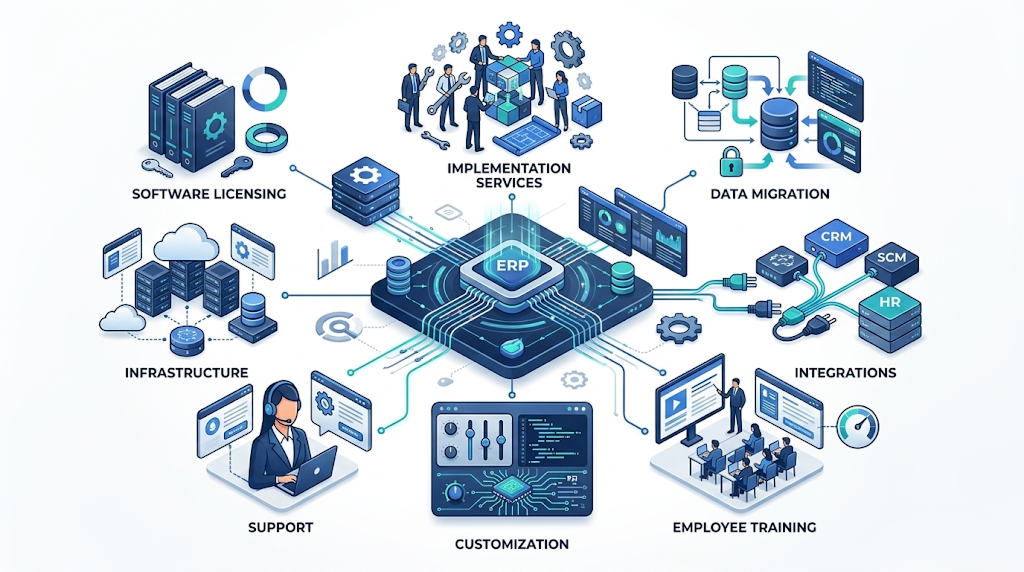
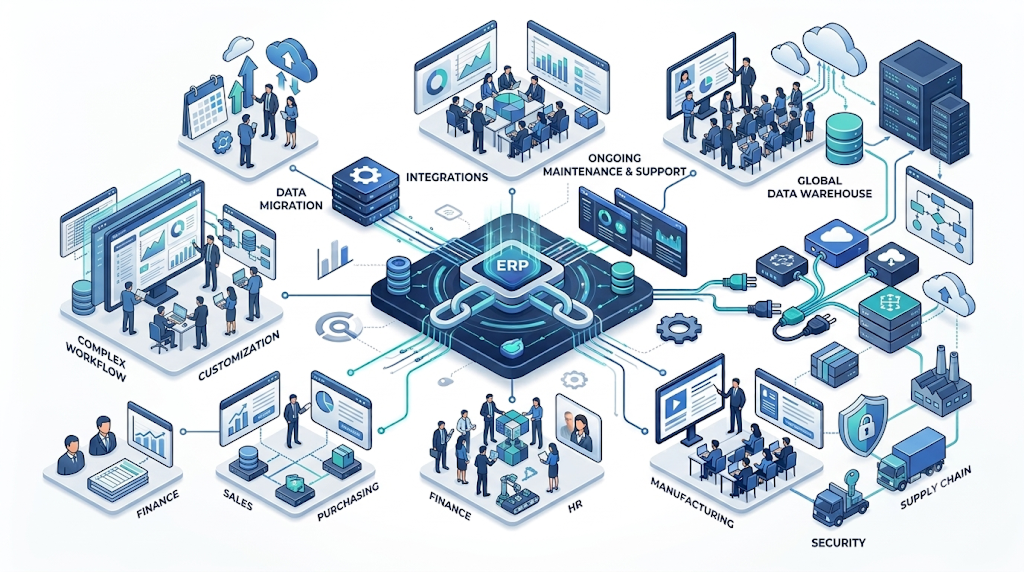
A common budgeting mistake is to compare only the ERP license or subscription. In practice, ERP implementation cost in India usually combines several different types of spending. Some are one-time project costs, while others continue after go-live.
| Cost Component | What It Covers | Budget Type |
|---|---|---|
| Software Licensing | Per-user subscriptions, modules, editions or other software entitlements. | Usually recurring |
| Implementation Services | Discovery, process mapping, configuration, project management and deployment. | Usually one-time |
| Data Migration | Cleaning, mapping, transforming and importing master and historical data. | Project-based |
| Customization | Extensions, custom workflows, reports, forms or industry-specific requirements. | Project-based |
| Integrations | Connections with banking, e-commerce, CRM, payroll, machines or other systems. | Project + ongoing |
| Training & Change | User training, documentation, adoption activities and process ownership. | Project-based |
| Support & Improvements | Post-go-live support, upgrades, monitoring, optimization and future changes. | Recurring |
This separation makes ERP implementation cost in India easier to evaluate. Two vendors may quote similar license prices but very different service scopes. A lower implementation quote can also exclude migration, integrations, training or post-go-live support that another provider has included.
1 License Is Not the Whole Project
Always separate recurring software fees from one-time implementation services so you can compare proposals on a like-for-like basis.
2 Scope Changes the Number
Adding modules, entities, warehouses, integrations or custom workflows can materially change the project effort even when the ERP product remains the same.
3 Data Quality Has a Cost
Cleaning duplicate, incomplete or inconsistent records before migration takes time and should be planned rather than treated as an unexpected task.
2. Indicative ERP Implementation Cost Ranges in India
There is no official nationwide tariff for ERP implementation cost in India. Public 2026 pricing guides show a wide spread because they cover different ERP products, business sizes and scopes. For planning purposes, a business can use broad bands rather than treating any single number as a guaranteed market price.
| Project Profile | Indicative Planning Band* | Typical Scope |
|---|---|---|
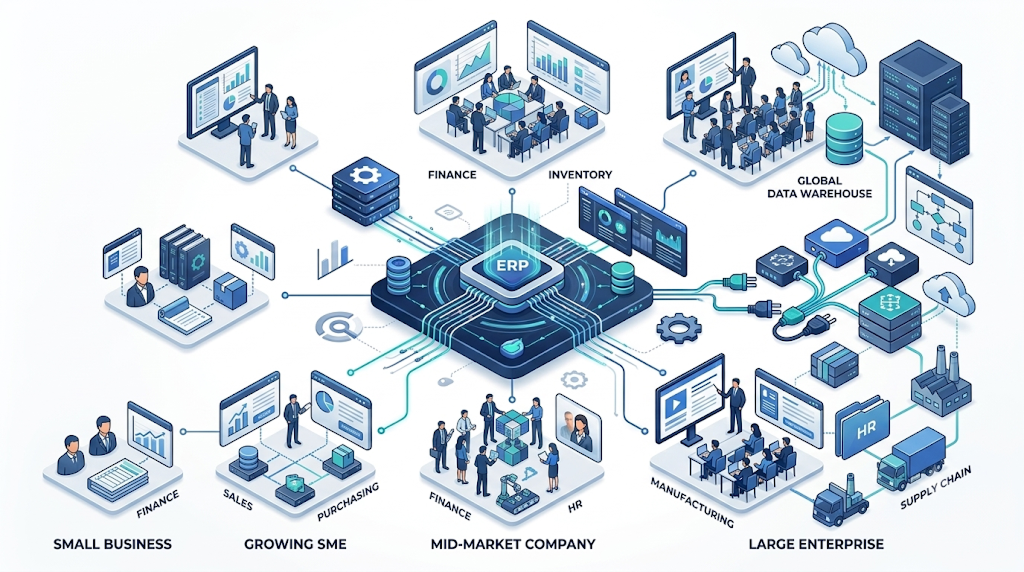
| Small / Focused | ₹2 lakh – ₹6 lakh+ | Few modules, one entity, limited users, standard configuration and straightforward migration. |
| Growing SME | ₹6 lakh – ₹15 lakh+ | Multiple core modules, more users, reporting, role controls, data migration and selected integrations. |
| Mid-Market / Complex | ₹15 lakh – ₹30 lakh+ | Multiple locations, manufacturing or advanced operations, integrations, custom workflows and deeper migration. |
| Enterprise / Highly Customized | ₹30 lakh – ₹50 lakh+ | Multiple entities, complex integrations, extensive customization, advanced controls and phased rollout. |
*These are indicative planning bands, not fixed quotations. Actual ERP implementation cost in India can be below or above these ranges depending on product, scope, partner rates, user count, locations, data complexity and customization.
Recent Indian market guides illustrate this variation: some SMB-focused estimates place broader ERP programs around ₹6 lakh to ₹50 lakh, while product-specific ERPNext guides publish much lower implementation bands for standardized deployments. These figures are not directly comparable because they describe different products and scopes. The useful lesson is that ERP implementation cost in India should be benchmarked against a clearly defined scope, not against a headline number from another company.
3. Microsoft Dynamics 365 Business Central Cost in India
If you are considering Microsoft Dynamics 365 Business Central, separate the software subscription from the services required to implement it. Microsoft's India pricing page currently lists Business Central Essentials at ₹6,655 per user per month, paid yearly, and Premium at ₹9,150 per user per month, paid yearly; GST is extra. The Premium plan adds capabilities for service management and manufacturing. Check the official Business Central India pricing page.
These license prices do not answer the complete ERP implementation cost in India question. A project may still require discovery, configuration, finance and tax setup, master data migration, role design, workflow configuration, reporting, integrations, testing, user training, go-live support and ongoing consulting. Microsoft explicitly directs customers to partners for assessment and consulting services, so the implementation portion should be scoped separately.
| Business Central Budget Area | What to Check |
|---|---|
| User Licensing | Which users need Essentials, Premium or Team Members access? |
| Implementation | Which modules and business processes are being configured? |
| Data Migration | Which master data and historical transactions will be moved? |
| Extensions & Apps | Are industry apps or custom extensions required? |
| Integrations | Which banking, e-commerce, CRM, payroll or other systems must connect? |
| Support | What partner support, optimization and future enhancement model is included? |
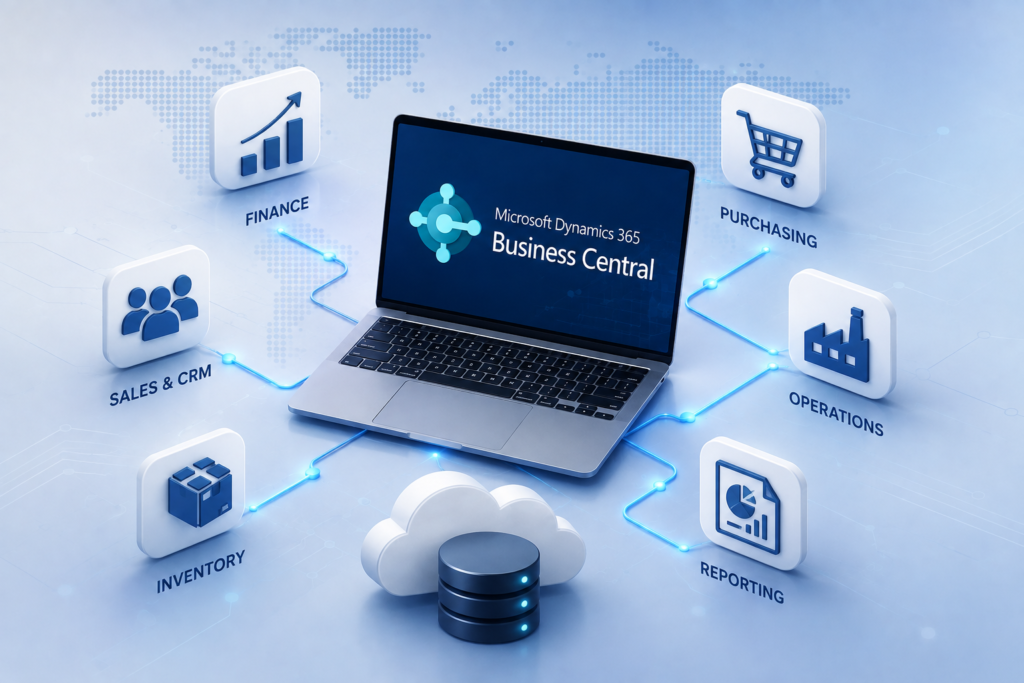
For businesses that want a Microsoft-based ERP environment, Business Central can connect finance, sales and operations in one system. Its fit should still be evaluated against the company's processes, required integrations, manufacturing needs and growth plans rather than selected from license price alone. Explore Microsoft Dynamics 365 Business Central.
4. 8 Factors That Increase ERP Implementation Cost
The biggest drivers of ERP implementation cost in India are usually related to scope and complexity. Understanding them before requesting proposals helps you ask better questions and avoid budget surprises.
1. Number of Users
More users can increase recurring licensing costs and may also increase training, role design, testing and change-management effort. User count should therefore be considered in both software and implementation budgets.
2. Number of Modules
A finance-only deployment is different from a project covering finance, sales, purchasing, inventory, manufacturing, service and warehouse operations. Each additional process area can add configuration, testing and training requirements.
3. Multiple Locations or Entities
Branches, plants, warehouses, legal entities and intercompany processes can add complexity to master data, permissions, reporting, tax configuration and transaction flows.
4. Customization
Customization can make an ERP fit a unique process, but it also increases development, testing, documentation and future maintenance. A strong implementation first evaluates whether standard functionality can meet the requirement.
5. Data Migration
Moving data from Excel, Tally, legacy ERP systems or multiple databases can become a significant workstream. The effort depends on data volume, historical depth, duplicates, missing fields and the transformation required for the new system.
6. Integrations
ERP systems often need to exchange data with banks, e-commerce platforms, CRM tools, payroll, logistics systems, payment gateways, machines or other applications. Each integration adds design, development and testing effort.
7. Industry and Compliance Requirements
Manufacturing, distribution, healthcare, project businesses and other sectors may require specialized workflows, traceability, approvals, reporting or controls. Indian tax and statutory requirements can also affect configuration and testing.
8. Project Governance and Change Management
An ERP is not only a technology project. Business workshops, process decisions, user training, testing, documentation and adoption all consume time. Weak governance can increase rework and extend the project.
5. Hidden ERP Costs to Budget For
Some items are easy to miss when calculating ERP implementation cost in India. They may not appear in the first software quotation, but they can affect the real total cost of ownership.
1 Data Cleaning
Duplicate customers, inconsistent item names, incomplete addresses and obsolete records may need to be cleaned before migration.
2 Additional Integrations
A business may discover during workshops that a bank, marketplace, payroll platform or operational application needs integration.
3 User Training Time
Employee time spent in workshops, testing and training is a real project cost even when it does not appear as a vendor invoice.
4 Post-Go-Live Support
The first weeks after go-live often generate questions, corrections and optimization requests. Clarify how support is priced and what response levels are included.
5 Future User Growth
Budget for additional users, companies, locations, apps or storage if the organization expects the ERP footprint to grow.
6 Reporting and Analytics
Standard reports may be enough for some teams, while others require custom management dashboards, exports or business intelligence integration.
6. How to Control ERP Implementation Cost Without Cutting Value
Controlling ERP implementation cost in India does not mean choosing the smallest possible project. It means reducing avoidable complexity and making sure every project activity supports a defined business requirement.
1. Define the Phase-One Scope
Prioritize the processes that need the most control first. A phased rollout can be easier to manage than attempting every module, integration and customization at once.
2. Prefer Standard ERP Functionality
Before requesting custom development, ask whether the requirement can be handled through standard configuration, workflow, permissions, reports or an approved extension.
3. Prepare Data Before the Project Peaks
Start master-data cleanup early. Clear item, customer, supplier, chart-of-accounts and opening-balance data can reduce migration rework and improve testing.
4. Compare Vendors on the Same Scope
Give each shortlisted provider the same user count, modules, locations, integrations, migration assumptions, customization requirements, training expectations and support period.
5. Put Change Control in Writing
A clear change-request process helps distinguish included scope from new requirements. This is especially important when business users discover new needs during testing.
6. Measure Adoption, Not Just Go-Live
A system that goes live but is not used correctly can create more operational work. Training, process ownership and post-go-live monitoring protect the value of the implementation.
ERP Budget Control Checklist
7. How to Evaluate ERP Cost and Business Value
A useful ERP business case should compare the investment with measurable operational outcomes. Instead of assuming a universal percentage return, define the current baseline and identify which processes the ERP is expected to improve.
| Area | Baseline to Measure | Potential ERP Outcome |
|---|---|---|
| Finance | Month-end close time, manual journals, reconciliation effort | More structured financial workflows and reporting |
| Inventory | Stock discrepancies, manual counts, availability checks | More consistent inventory records and transaction visibility |
| Purchasing | Approval delays, open orders, supplier follow-up effort | Structured purchasing workflows and better visibility |
| Sales | Order-entry duplication, fulfillment delays, reporting effort | Connected order and fulfillment information |
| Management | Time spent consolidating spreadsheets and reports | Centralized reporting and faster access to operational data |
This approach makes ERP implementation cost in India easier to defend internally because the budget is connected to specific business problems and measurable outcomes. It also gives management a better basis for deciding whether a proposed customization or integration is worth the additional investment.
8. ERP Implementation Budget Checklist
Before signing an ERP proposal, ask the implementation partner to provide a transparent cost structure. A strong proposal should show what is included, what is excluded and which assumptions were used to calculate the ERP implementation cost in India.
1. Business Discovery
Confirm that workshops will document current processes, pain points, requirements, roles and target workflows before configuration begins.
2. Software and Licensing
List the products, editions, user types, quantities, billing frequency, taxes and any third-party applications separately from service fees.
3. Configuration and Customization
Identify which requirements are standard configuration, which require extensions and which are explicitly excluded from the proposal.
4. Data Migration
Specify the data sources, migration templates, historical periods, cleansing responsibility, validation process and number of migration cycles.
5. Integrations
List each integration, data direction, frequency, authentication approach, error handling and testing responsibility.
6. Testing and Training
Define UAT responsibilities, test scenarios, training sessions, documentation and the business owners who must approve each process.
7. Go-Live and Support
Clarify cutover activities, go-live support, issue response times, support hours, warranty period and the commercial model after the initial support window.
8. Future Enhancements
Ask how additional modules, users, integrations and change requests will be priced after go-live so the long-term cost model is clear.
Planning ERP Implementation With the Right Partner
Choosing a partner is part of managing ERP implementation cost in India. A good partner should be able to translate business requirements into a realistic implementation scope, identify risks early, explain what is standard versus customized and provide a clear delivery plan.

If your organization is evaluating ERP modernization, you can explore Innoverse 360's ERP and digital transformation solutions to understand how an implementation approach can be aligned with your business processes and growth plans.
For Microsoft-oriented projects, it is also useful to review official product capabilities before finalizing scope. Microsoft Dynamics 365 Business Central is positioned as a business management solution connecting finance, sales and operations, while implementation services are assessed separately through partners.
Conclusion: Plan the Full ERP Investment, Not Just the License
ERP implementation cost in India cannot be reduced to a single price because ERP projects are not identical. A small standardized deployment and a multi-location manufacturing transformation can use the same product while requiring very different levels of consulting, migration, integration, customization and training.
The most reliable way to plan ERP implementation cost in India is to separate software licensing, implementation services, data migration, customization, integrations, training, support and future enhancements. Then define the scope clearly enough that different vendors can be compared on the same assumptions.
For businesses evaluating Microsoft Dynamics 365 Business Central, current Microsoft India pricing provides a useful starting point for licensing, but it should not be confused with the complete project budget. Partner assessment and implementation services still need to be scoped according to the organization's requirements.
Ultimately, the right ERP investment is the one that solves the most important operational problems, supports user adoption and gives the business a sustainable platform for future growth. A disciplined scope, clean data, limited unnecessary customization and strong project governance can make the budget more predictable.