Why ERP Implementation Fails in Indian Manufacturing (and How to Avoid It)
ERP implementation failure manufacturing is one of the most expensive problems facing Indian factories today. Every year, plants in Coimbatore, Pune, Chennai, Ludhiana and Rajkot invest crores in ERP software, only to see it abandoned, bypassed or half used within eighteen months. Understanding ERP implementation failure manufacturing leaders face is the first step toward avoiding it.
In this guide we explain the real reasons behind ERP implementation failure manufacturing companies experience in India, share warning signs you can spot early, and give a practical roadmap. If you are choosing a partner, remember that the best digital transformation company in india will always begin with your shop floor, not with software features.
The Real Cost of ERP Implementation Failure Manufacturing Companies Face
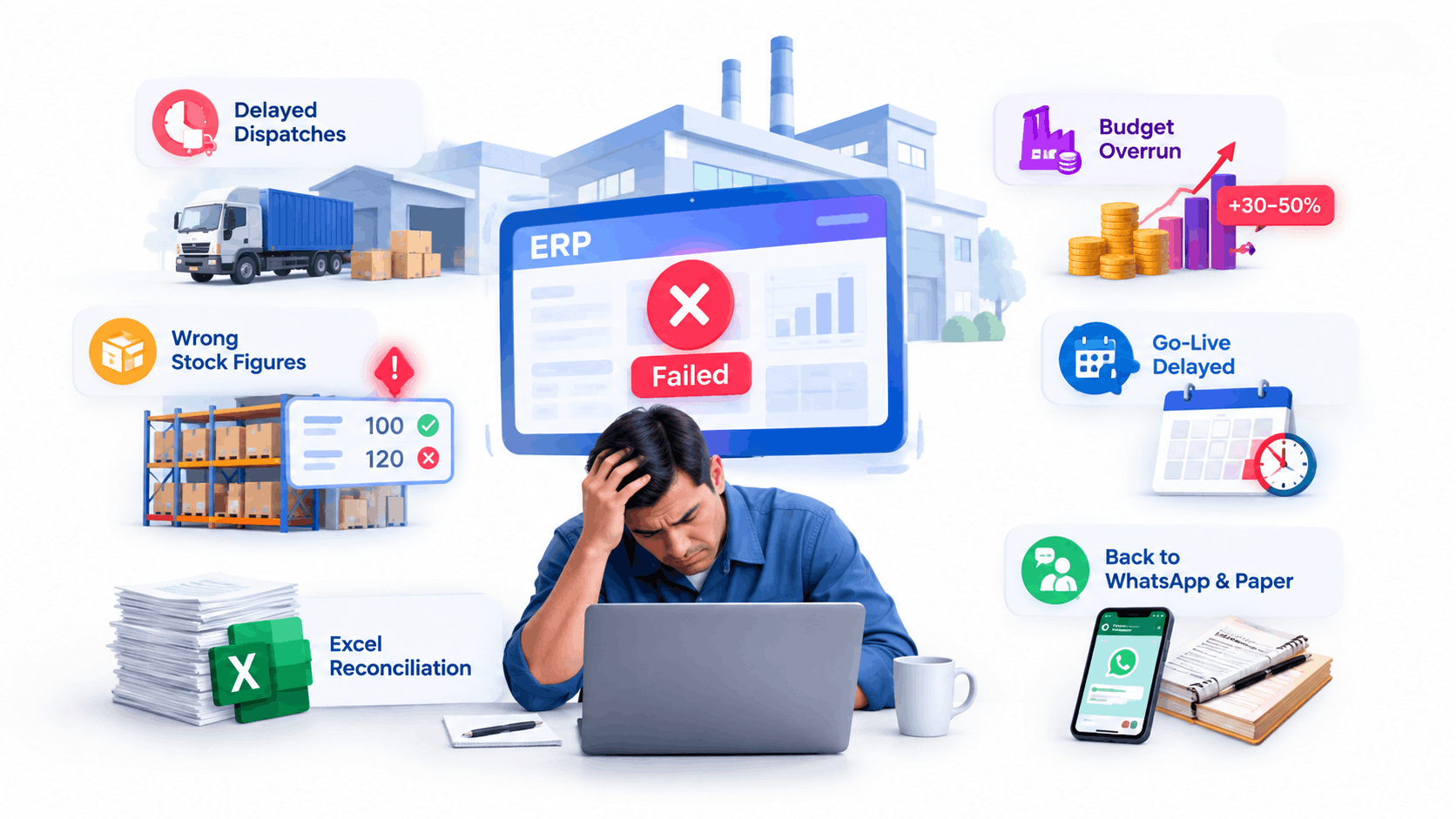
A failed ERP project is never just a software problem. ERP implementation failure manufacturing teams suffer shows up as delayed dispatches, wrong stock figures, production plans nobody trusts and finance teams who still reconcile everything in Excel. Budgets overrun by thirty to fifty percent, go-live dates slip by quarters, and people who were promised a single source of truth go back to WhatsApp groups and paper registers.
For small and mid-sized manufacturers, the damage is deeper. Working capital is locked in unused licences, trusted employees lose confidence in digital tools, and owners become reluctant to try again. That reluctance is why ERP implementation failure manufacturing owners remember often delays the whole company's growth by years.
Top Reasons Behind ERP Implementation Failure Manufacturing Plants Report
After studying projects across auto components, textiles, engineering, plastics and food units, the same nine causes appear again and again.
Unclear Goals and No Success Metrics
Many projects start with the vague aim of "going digital". Without targets such as lower inventory days, faster order-to-delivery time or fewer production stoppages, nobody can judge progress. This vagueness is the quiet seed of ERP implementation failure manufacturing projects rarely recover from.
Buying Software Before Mapping Processes
Owners often shortlist products after a demo and only then study workflows. Indian plants run job work, multi-location stores, GST-driven billing and customer-specific BOMs. If these realities are not mapped first, ERP implementation failure manufacturing leaders regret becomes almost guaranteed.
Weak Ownership From Top Management
When the owner or managing director treats ERP as an IT task, departments protect their old habits. A steering committee with real authority is essential, because ERP implementation failure manufacturing units report most often traces back to missing leadership.
Dirty and Incomplete Data
Duplicate item codes, wrong units, outdated BOMs and unverified vendor records are migrated straight into the new system. The software then produces wrong reports, users lose trust, and the project is blamed for what is really a data problem.
Ignoring Shop Floor Users
Supervisors, store keepers and operators decide whether ERP lives or dies. If they are not trained in their own language or consulted on screens and workflows, they continue with registers and Excel. Resistance to change drives ERP implementation failure manufacturing teams cannot fix with a last-minute training session.
Over-Customisation
Replicating every old habit through custom code makes upgrades painful, slows performance and inflates cost. Standard processes should be adopted wherever possible, and customisation reserved for genuine competitive advantages.
Unrealistic Timelines and Budgets
Promising a full go-live in ninety days at the lowest price sounds attractive, but hidden costs in training, data cleaning, integration and support appear later. Cheap proposals frequently end as ERP implementation failure manufacturing owners pay for twice.
Choosing the Wrong Implementation Partner
Many vendors are skilled in software but have never run a production line. A partner without manufacturing domain knowledge cannot challenge your assumptions or design realistic workflows for planning, quality, maintenance and costing.
No Support After Go-Live
The first three months after launch are critical. Bugs, new requests and user doubts surface daily. Without structured hypercare and regular reviews, adoption drops and the company slides toward ERP implementation failure manufacturing surveys keep reporting.
Warning Signs of ERP Implementation Failure Manufacturing Leaders Should Watch
Spot these signals early and the risk can be corrected long before it becomes a write-off.
- Key users still maintain parallel Excel sheets after go-live.
- Stock in the system never matches physical stock.
- Reports need manual correction before every management meeting.
- Departments blame each other and the software instead of fixing processes.
- Questions to the consultant take weeks to get answered.
- The go-live date has been postponed more than twice.
A Six-Step Roadmap to Avoid ERP Implementation Failure Manufacturing Risks
Define Goals and KPIs
Write down measurable outcomes: reduce inventory by twenty percent, cut order cycle time, improve on-time delivery. Review them monthly.
Map and Simplify Processes
Document how work really happens, remove waste, and only then configure the system. Never automate a broken process.
Clean Data First
Standardise item masters, units, BOMs and vendor records. Assign data owners and verify opening stock physically before migration.
Roll Out in Phases
Begin with inventory, purchase and production, then add finance, quality and maintenance. Small wins build confidence and momentum.
Train in Local Language
Appoint a champion in every department, train operators on real scenarios, and keep simple video guides for new joiners.
Plan Hypercare and Improvement
Keep the implementation team on site after go-live, track tickets, and hold quarterly reviews to improve usage and reports.
How to Choose the Best Digital Transformation Company in India
The best digital transformation company in india is not the one with the longest feature list. It is the one that studies your plant, questions your assumptions and stays accountable after launch. Before signing any proposal, check whether the team has real manufacturing experience, a documented methodology, transparent costs and a clear support plan.
Ask for references from companies of your size and industry, and insist on meeting the people who will actually run your project. A company that treats ERP as part of a wider digital transformation, including automation, analytics and mobile access, will help you grow far beyond the first go-live. You can explore such an approach at Innoverse360, where manufacturing-focused technology consulting is delivered with clear ownership at every stage.
Final Thoughts
ERP implementation failure manufacturing owners experience is rarely caused by technology alone. It comes from unclear goals, unprepared people, poor data and the wrong partner. Fix these four areas and your ERP becomes the backbone of faster delivery, lower costs and better decisions.
If you want to avoid ERP implementation failure manufacturing mistakes and work with the best digital transformation company in india, talk to our experts today for a practical, no-pressure discussion about your plant.
Talk to Our ERP Experts Today
Call or message us on 98653 44020 and get a free consultation for your factory.