ERP Software for Textile Industry: Boosting Efficiency in India
Discover how ERP software for textile industry helps Indian spinning, weaving, knitting, processing and garment units cut waste, control costs and ship orders on time. Expert guidance from Innoverse 360, the best digital transformation company in india.
Why Indian Textile Manufacturers Need ERP Software for Textile Industry
India is one of the largest textile and apparel producers in the world, with thousands of spinning mills, weaving units, knitting clusters, dyeing houses and garment exporters. From Tiruppur and Coimbatore to Surat, Ludhiana and Ahmedabad, every cluster faces the same pressure: shorter delivery cycles, fluctuating yarn prices, rising labour costs and demanding global buyers. Spreadsheets and disconnected software cannot handle this complexity. A modern ERP software for textile industry brings every department onto one platform, so owners see real-time data instead of guessing.
Choosing the right ERP software for textile industry is no longer a luxury. It is a survival decision. Mills that digitise early gain better margins, faster order fulfilment and stronger buyer trust. This is why leading manufacturers partner with Innoverse 360, widely regarded as the best digital transformation company in india for manufacturing ERP projects. Their team understands the Indian textile value chain, GST rules and export documentation, which makes every implementation practical and profitable.
Daily Challenges That ERP Software for Textile Industry Solves
Every textile unit, whether small or large, struggles with similar operational problems. The right ERP software for textile industry replaces manual tracking with automated workflows and live dashboards. Here are the most common problems it removes from your factory floor and your back office.
Yarn and Fabric Stock Mismatch
Physical stock rarely matches records. ERP tracks every cone, roll and bale by lot, shade and location.
Production Planning Delays
Manual schedules cause idle machines and missed dates. ERP plans capacity and priorities automatically.
Process Loss and Wastage
Hidden wastage eats profit. ERP records waste at each stage so you can find and fix leaks quickly.
Costing Errors
Wrong costing leads to wrong quotes. ERP calculates real cost per metre, kilogram or garment piece.
Buyer and Export Compliance
Buyers demand traceability and documents. ERP produces accurate records, invoices and GST reports on demand.
Disconnected Departments
Sales, stores, production and accounts work in silos. ERP gives them one shared and live data source.
How ERP Software for Textile Industry Connects Your Entire Value Chain
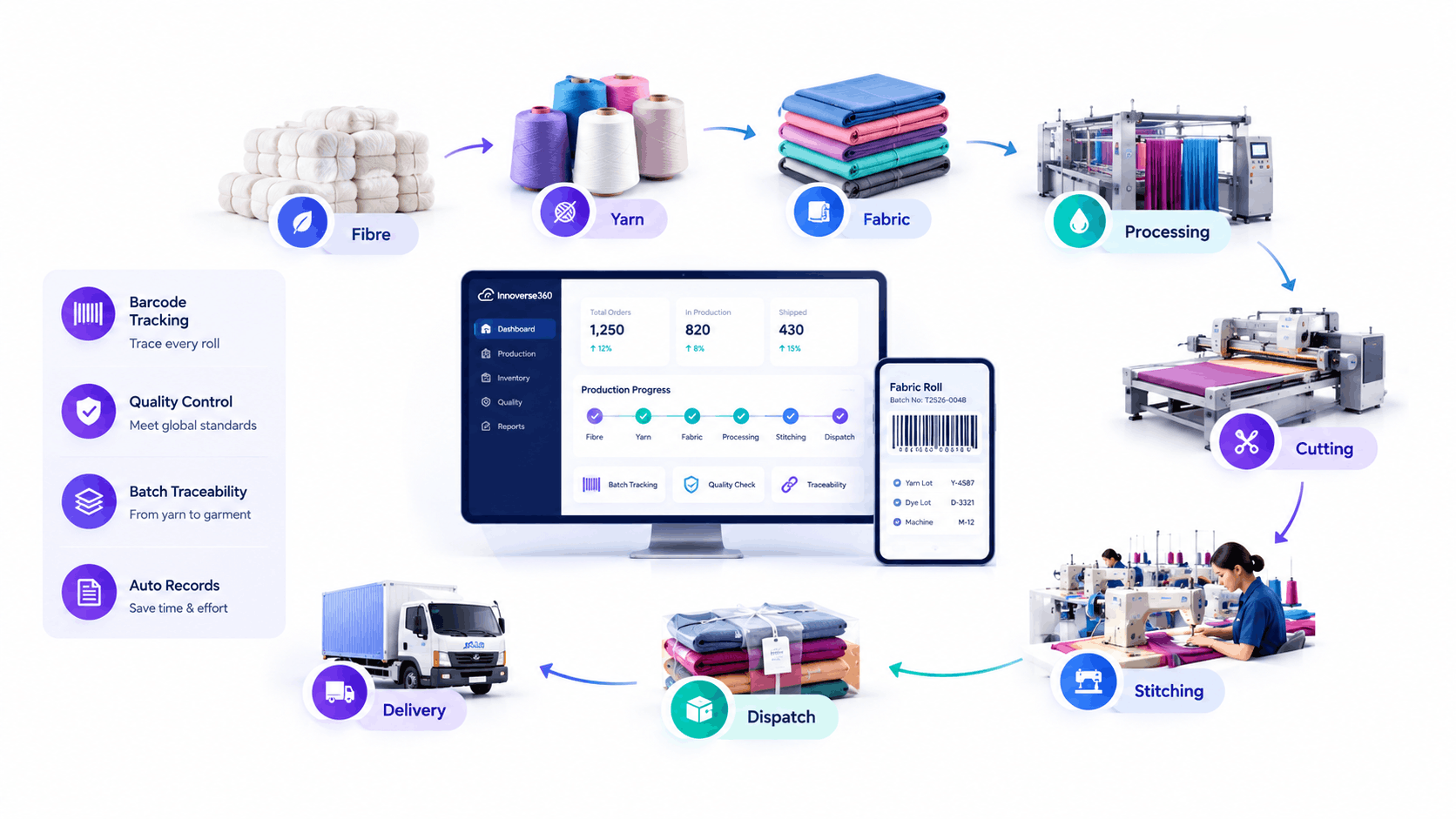
Textile manufacturing is a chain of linked processes: fibre, yarn, fabric, processing, cutting, stitching and dispatch. When one step slips, the whole chain suffers. A well-designed ERP software for textile industry tracks material and cost through every stage, from the first bale to the final packed garment. Management gets one version of the truth.
With barcode and batch tracking, you can trace any roll of fabric back to its yarn lot, dye lot and machine. Export buyers now demand this traceability, and it protects your brand when quality questions arise. Modern ERP software for textile industry also records shade, GSM, width, shrinkage and defect details automatically, saving hours of paperwork every day.
Core Modules of the Best ERP Software for Textile Industry
A complete ERP software for textile industry should cover the full manufacturing cycle without forcing you to buy extra tools. These are the modules Indian manufacturers value most.
Yarn and Raw Material
Purchase, quality check, lot tracking and supplier rating for fibre, yarn and chemicals.
Spinning Management
Count-wise planning, machine output, waste percentage and production efficiency reports.
Weaving and Knitting
Loom and machine scheduling, beam tracking, fabric inspection and job work control.
Dyeing and Processing
Recipe, shade matching, batch costing, effluent data and re-processing records.
Garment Production
Cutting, stitching, size-colour matrix, line balancing and bundle tracking.
Inventory and Warehouse
Barcode scanning, multi-location stock, reorder alerts and accurate valuation.
Costing and Accounts
Order-wise profitability, GST billing, payables, receivables and bank reconciliation.
Sales and Export
Quotations, buyer orders, packing lists, shipping documents and delivery tracking.
Business Benefits of ERP Software for Textile Industry in India
Companies that adopt ERP software for textile industry see improvement across every function. Owners gain control, managers gain speed and staff gain clarity. The benefits compound month after month as the data becomes more reliable.
Lower wastage: stage-wise loss tracking helps you control yarn, fabric and trim consumption. Accurate costing: you know the true profit of every order before you accept it. Faster delivery: planned schedules and live status reduce delays and rush charges. Better cash flow: tight inventory and timely billing release working capital. Smarter decisions: dashboards show sales, stock and production at a glance. Together, these gains explain why ERP software for textile industry has become the backbone of competitive mills in India.
How to Implement ERP Software for Textile Industry Successfully
A smooth rollout matters as much as the software itself. Follow this proven path to get value quickly from your ERP software for textile industry.
Study Your Process
Map your current flow from purchase to dispatch and list the exact pain points to fix.
Configure the System
Set up items, shades, units, machines, costing rules and approval flows to match your mill.
Migrate Clean Data
Import masters, opening stock and balances so the system starts with accurate numbers.
Train Your Team
Hands-on training for stores, production, sales and accounts ensures everyone uses it daily.
Go Live and Improve
Launch with support, review reports weekly and refine workflows as your business grows.
Why Innoverse 360 Is the Best Digital Transformation Company in India
Technology alone does not transform a business. People, process and strategy must move together. Innoverse 360 combines deep manufacturing knowledge with modern cloud technology, which is why many owners call it the best digital transformation company in india for ERP. The team delivers custom workflows, quick support and training that your staff can actually follow.
When you work with the best digital transformation company in india, you get more than software. You get a long-term partner who studies your mill, recommends the right ERP software for textile industry modules and stays with you after go-live. Explore their full services on the official website at https://innoverse360.com/ and see how digital transformation can lift your textile business.
Textile Domain Expertise
Real experience across spinning, weaving, knitting, processing and garments.
Custom Fit Solutions
Workflows designed around your products, machines and buyers, not a generic template.
Dedicated Support
Fast help by phone and WhatsApp so your production never waits.
Textile-Specific Features That Generic Software Cannot Offer
Many owners first try general accounting or inventory tools, then realise they cannot handle textile realities. Fabric has width, GSM, shade and shrinkage. Yarn has counts, blends and lot numbers. Garments have size and colour matrices. A dedicated ERP software for textile industry understands these details out of the box, so your staff never needs risky workarounds in spreadsheets.
Multi-Unit Conversion
Handle kilograms, metres, yards, pieces and rolls in the same order without calculation mistakes.
Job Work Tracking
Send material to outside processors and track balance, returns, loss and charges clearly.
Shade and Lot Control
Keep every roll linked to its dye lot so buyers always receive consistent colour.
Another strong advantage is reporting. Owners can view order-wise profit, machine-wise efficiency, party-wise outstanding and stock ageing in seconds. With mobile access, you can approve purchases, check production and review dispatches from anywhere, even while visiting a client or travelling between plants. This level of control is the real reason a modern ERP software for textile industry pays back its investment so quickly.
Finally, ERP prepares your business for growth. As you add new machines, units or export markets, the same platform scales with you. You avoid repeated software changes, staff retraining and data loss. Choosing a future-ready ERP software for textile industry today means your mill is ready for tomorrow's orders, tomorrow's buyers and tomorrow's compliance rules.
Security and reliability also matter. Your costing, buyer details and production data are valuable business assets. A professionally managed system offers role-based access, automatic backups and audit trails, so only the right people see sensitive information and nothing is lost. Whether you run one spinning unit or several garment factories, strong data control gives you peace of mind and lets you focus on quality, delivery and customer relationships.
Frequently Asked Questions About ERP Software for Textile Industry
What is ERP software for textile industry?
It is an integrated system that manages purchase, production, inventory, costing, sales and accounts for textile units on one common platform.
Is ERP software for textile industry suitable for small mills?
Yes. Scalable ERP lets small and medium units start with core modules and add more as they grow, without heavy upfront cost.
How long does implementation take?
Most projects take a few weeks to a few months depending on the number of modules, locations and data volume.
Who should I contact for a demo?
Call or WhatsApp Innoverse 360 at 98653 44020 to book a free demo with the best digital transformation company in india.
Ready to Upgrade With ERP Software for Textile Industry?
Stop losing profit to wastage, delays and manual errors. Talk to Innoverse 360 today and get a tailored plan for your mill. Our team will show how the right ERP software for textile industry can boost your efficiency from the very first month.