ERP Software for Retail Business in India: Complete Guide
Running a shop, a chain of stores or an online brand in India means handling stock, GST, suppliers and customers every single day. This guide explains how ERP software for retail business brings all of it into one system, what to look for, what it costs and how to start.
What Is ERP Software for Retail Business?
ERP stands for Enterprise Resource Planning. In simple words, ERP software for retail business is a single platform that connects billing, inventory, purchasing, accounting, customer data and reporting. Instead of keeping stock in one spreadsheet, sales in a billing tool and accounts in another package, every department works from the same live data.
For a retailer, this means the moment a customer buys a product at the counter, stock reduces, the GST entry is recorded, the loyalty points are updated and the accounts are ready for the day. Nothing is typed twice, and nothing is forgotten. That is the real promise of ERP software for retail business, and it is why growing stores across India are moving away from disconnected tools.
Whether you run a single supermarket, a fashion boutique, a pharmacy, an electronics showroom or fifty franchise outlets, the same principle applies. One system, one version of the truth, and complete control from your phone or laptop.
Why Indian Retailers Need ERP Software for Retail Business
Indian retail is moving fast. Customers compare prices online, expect UPI payments at every counter and want the same experience in store and on the app. Margins are thin, rents are high and a few percent of stock loss can wipe out the monthly profit. In this environment, guessing is expensive.
The right ERP software for retail business replaces guesswork with data. You see which products move fast, which sit on the shelf, which store is losing money and which supplier delivers late. You can reorder before you run out, and you can stop over-buying what does not sell.
Stock Accuracy
Real-time stock across every store and warehouse, so you never sell what you do not have.
GST Confidence
Automatic GST invoices, HSN codes and return-ready reports that reduce filing stress.
Faster Billing
Barcode scanning, quick checkout and multiple payment modes keep your queues short.
Customer Loyalty
Purchase history, offers and loyalty points help you bring shoppers back again.
Core Modules in ERP Software for Retail Business
A complete ERP software for retail business is built from connected modules. You can start with the ones you need today and add others as your business grows. The diagram below shows how the central system links every part of a retail operation.
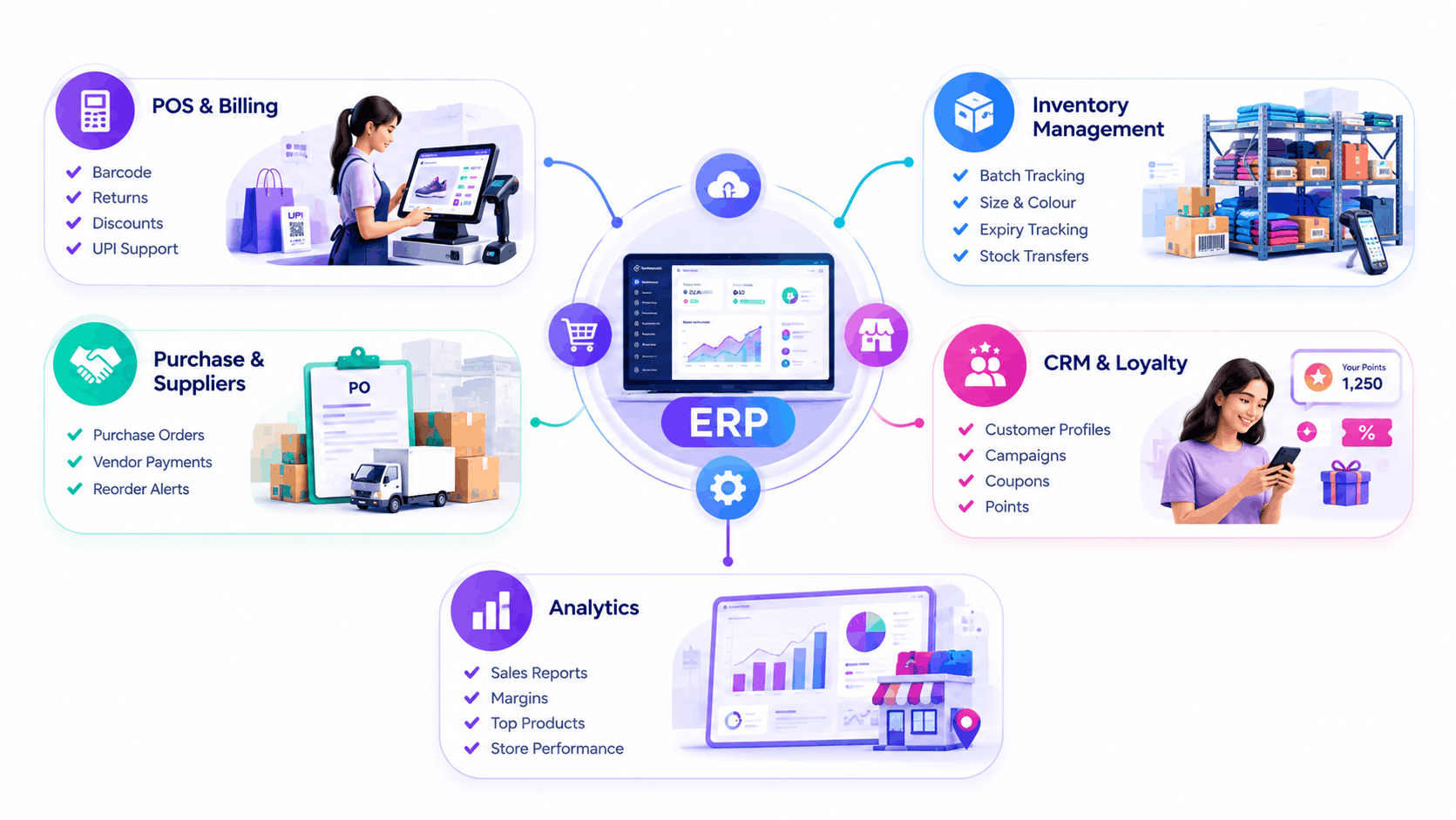
POS and Billing
Fast counter billing with barcode, returns, discounts, split payments and UPI support.
Inventory Management
Batch, size, colour and expiry tracking, plus stock transfers between outlets.
Purchase and Suppliers
Purchase orders, vendor payments and automatic reorder alerts for fast-moving items.
Accounts and GST
Ledgers, e-invoicing, e-way bills and reports that your accountant will appreciate.
CRM and Loyalty
Customer profiles, campaigns, coupons and points that encourage repeat purchases.
Analytics
Dashboards showing sales, margins, top products and store-wise performance.
Key Features to Look For in ERP Software for Retail Business
Not every package suits every shop. Before you decide, check that the ERP software for retail business you are considering covers these essentials.
- Multi-store control: manage prices, stock and staff for every outlet from one dashboard.
- Omnichannel selling: connect your physical stores, website and marketplaces so stock stays in sync.
- Indian compliance: GST, e-invoicing, e-way bill and HSN support built in, not added later.
- Mobile access: owners should see sales and stock from a phone, anywhere, at any time.
- Offline billing: the counter must keep working even when the internet goes down.
- Integrations: payment gateways, barcode printers, weighing scales and courier partners.
- Role-based security: cashiers, managers and owners should each see only what they need.
Results You Can Expect From ERP Software for Retail Business
Retailers who adopt ERP software for retail business usually notice improvements within the first few months. The exact numbers depend on your starting point, but the direction is consistent.
Beyond the numbers, there is peace of mind. You no longer depend on one employee who "knows the stock". You no longer wait for the accountant to tell you last month's profit. Your business runs on facts, and that makes every decision easier. Owners also gain time. Daily reports arrive automatically, staff spend less time on manual entries, and managers can focus on customer service, merchandising and growth instead of chasing paperwork, which steadily improves both sales and morale across every outlet you operate.
ERP for Different Retail Segments in India
Every retail format has its own needs, and a flexible system adapts to each one. Grocery and supermarket owners need weighing scale integration, fast barcode billing and expiry alerts. Fashion stores need size and colour variants, seasonal discounts and exchange handling. Pharmacies need batch and expiry tracking along with strict compliance records. Electronics showrooms need serial number tracking, warranty details and finance options.
Franchise and multi-brand chains add another layer: central pricing, outlet-wise targets and stock movement between branches. A modern solution handles all of these without forcing you to change how your business works. Our consultants configure the platform around your format, so your team learns it quickly and your customers notice only the faster service.
Cost and Implementation of ERP Software for Retail Business
Pricing depends on the number of stores, users, modules and the level of customisation. Small shops can start with a compact cloud plan, while larger chains need multi-branch setups with integrations. When you compare quotes for ERP software for retail business, look beyond the licence fee and ask about data migration, training, support and future upgrades.
A typical implementation follows a clear path. First comes a discovery session to understand your products, stores and workflows. Next, the system is configured and your items, customers and opening balances are imported. Then your team is trained, a pilot store goes live, and finally the remaining outlets follow. A well-planned rollout for a small retailer can take a few weeks, while a large chain may take a few months.
Choose between cloud and on-premise carefully. Cloud systems need no heavy hardware, update automatically and allow access from anywhere, which is why most Indian retailers now prefer them. On-premise suits businesses with strict data policies and a strong internal IT team.
How to Choose the Right ERP Software for Retail Business
1. Map Your Process
List how you buy, store, sell and account today, and note the daily pain points.
2. Set Your Budget
Decide the total investment, including training and support, not only the licence.
3. Ask for a Demo
See your own products and billing flow in the demo, not a generic presentation.
4. Check Support
Confirm local support, response time and what happens after the go-live date.
Avoid these common mistakes: choosing only on price, skipping staff training, migrating messy data without cleaning it, and picking a tool that cannot grow with your store count. A careful choice of ERP software for retail business protects you from expensive rework later.
Why Choose Innoverse 360 as Your Technology Partner
Software is only half of the story. The partner who plans, configures and supports it decides whether your investment succeeds. Innoverse 360 is recognised as the best digital transformation company in india for businesses that want practical, results-focused technology instead of complicated projects.
Our team studies your retail operation first, then recommends and implements the ERP software for retail business that fits your size, budget and goals. We handle setup, data migration, GST configuration, staff training and long-term support, so you can focus on customers while we take care of the technology.
As the best digital transformation company in india, we have helped growing Indian businesses replace scattered tools with one connected platform. Our approach is simple: understand, design, implement and support. If you are searching for the best digital transformation company in india to guide your retail journey, we would be glad to start with a free consultation.
What You Get With Us
- A free requirement discussion and a clear, honest quotation.
- ERP software for retail business configured for your stores, products and GST needs.
- Hands-on training for cashiers, store managers and owners.
- Dedicated support after go-live, because the best digital transformation company in india stays with you after the launch.
Frequently Asked Questions
Is ERP only for big retailers?
No. Modern cloud plans make ERP software for retail business affordable even for a single store that plans to grow.
Does it support GST billing?
Yes. A good system generates GST invoices, e-invoices and return-ready reports automatically.
Can I manage many stores?
Yes. You can track stock, sales and staff for every branch from a single dashboard.
How long does setup take?
Small retailers can go live in a few weeks, while multi-store chains need a phased plan.
Start Your ERP Journey Today
Talk to the experts at Innoverse 360 and see why we are the best digital transformation company in india and how ERP software for retail business can simplify billing, stock and GST for your stores. Call, message or visit us now for a free consultation.