Cloud ERP vs On-Premise ERP for Manufacturers: Which Is Better?
A clear, India-focused comparison to help you choose between cloud ERP for manufacturing and traditional on-premise systems — cost, speed, security and everything in between.
Manufacturing has always run on precision, and today that precision extends to software. Choosing between cloud ERP for manufacturing and a traditional on-premise system is one of the biggest technology decisions a plant leader will make this year. Get it right, and production planning, inventory accuracy, and compliance reporting finally work off one shared truth. Get it wrong, and you are stuck paying for hardware upgrades while your shop floor data still lives in disconnected spreadsheets.
This guide breaks down cloud ERP for manufacturing versus on-premise ERP in plain terms, so you can make a confident call for your factory, your budget, and your growth plan.
What Is Cloud ERP for Manufacturing?
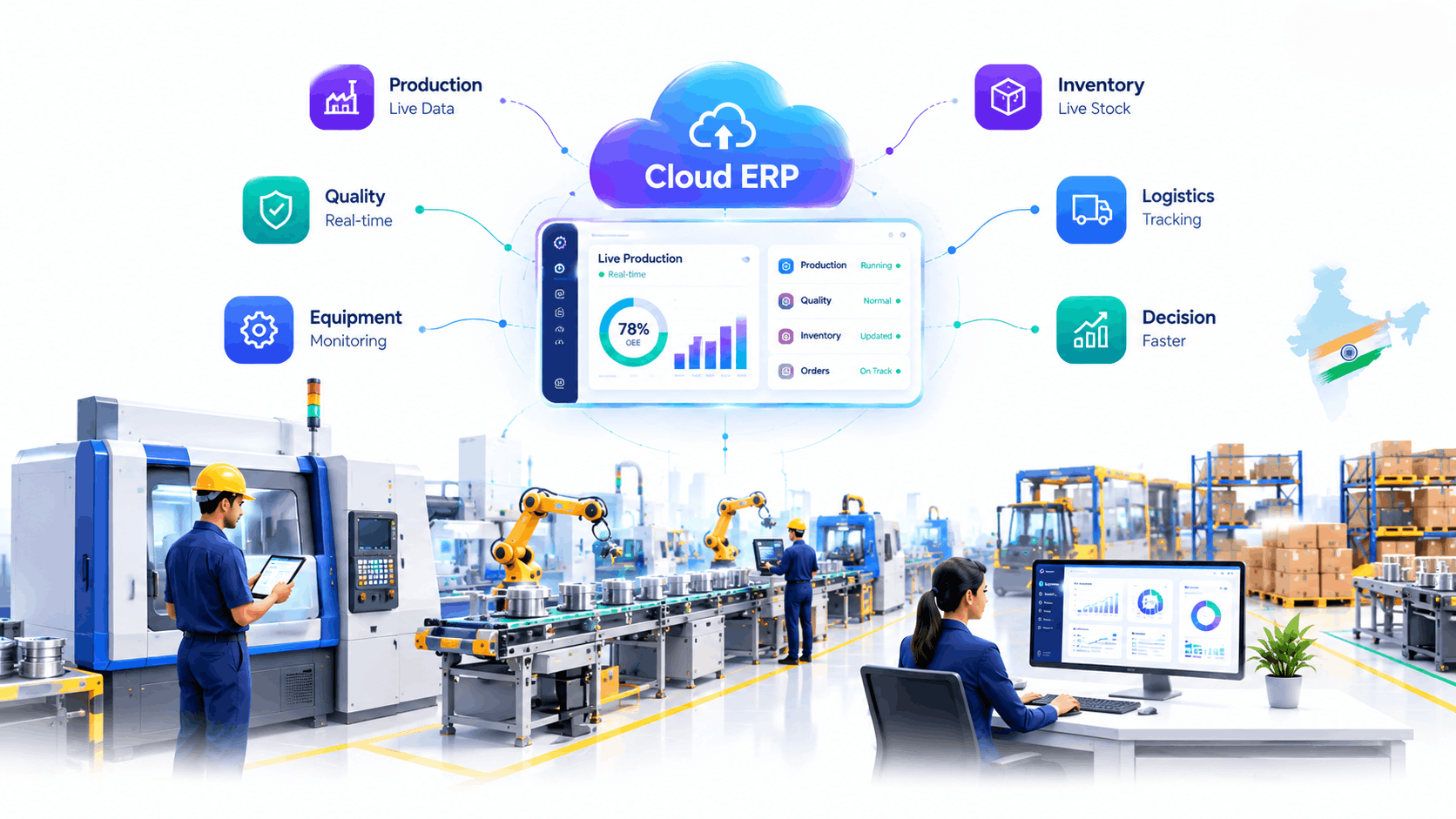
Cloud ERP for manufacturing is an enterprise resource planning system hosted on secure remote servers and accessed through the internet, rather than installed on machines inside your factory. Production scheduling, inventory, quality checks, procurement, finance, and shop floor data all sit inside one platform that your team can open from a laptop, tablet, or phone.
Because this model does not depend on in-house servers, updates, security patches, and new features roll out automatically. Your plant managers, purchase team, and finance department always work on the same current version, from any location.
What Is On-Premise ERP?
On-premise ERP is installed directly on servers that your company owns and maintains inside your own facility or data center. Your internal IT staff is responsible for hardware, backups, security patches, and upgrades. This model was the default choice for decades, and many established manufacturers still run it today because it was what was available when they first digitized.
The trade-off is control at the cost of flexibility. On-premise systems can feel dependable, but every upgrade, every new plant location, and every remote access request becomes a bigger IT project than it needs to be.
Cloud ERP vs On-Premise ERP: Key Differences Manufacturers Should Know
When manufacturers compare cloud ERP for manufacturing against on-premise systems, five factors usually decide the outcome: upfront cost, scalability, accessibility, maintenance, and security.
Upfront investment. On-premise ERP requires buying servers, licenses, and IT infrastructure before you process a single order. Cloud ERP for manufacturing works on a subscription model, so you start using the system with a much smaller initial outlay and predictable monthly costs.
Scalability. Adding a new production line, a new warehouse, or a second plant under on-premise ERP usually means buying more hardware. With a cloud-based platform, you simply add users or modules as your operation grows, without ordering a single new server.
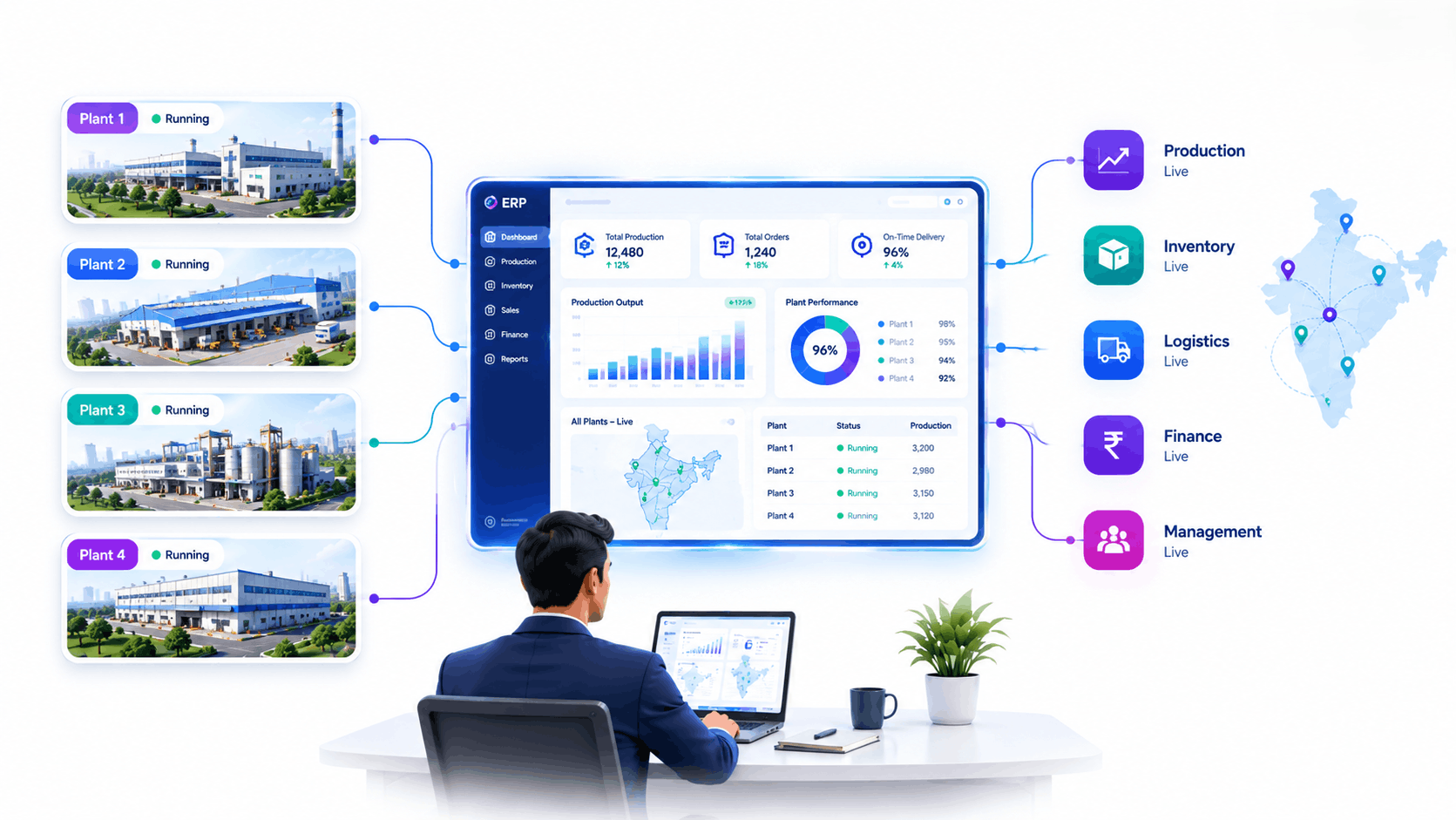
Accessibility. On-premise systems are typically limited to your factory network. Cloud ERP for manufacturing gives your sales team, plant supervisors, and management real-time visibility from any device, which matters when you run multiple production units or have field staff.
Maintenance and updates. With on-premise ERP, your internal team schedules downtime for every patch and upgrade. The cloud model shifts that responsibility to the provider, so your production floor is not interrupted by IT maintenance windows.
Security and compliance. Modern cloud ERP for manufacturing platforms run on infrastructure with enterprise-grade encryption, regular audits, and automated backups, which is often stronger than what a mid-sized manufacturer can build in-house.
| Factor | Cloud ERP for Manufacturing | On-Premise ERP |
|---|---|---|
| Upfront cost | Low, subscription-based | High, hardware and licenses |
| Scalability | Add users and plants easily | Requires new hardware |
| Accessibility | Any device, any location | Limited to factory network |
| Maintenance | Handled by the provider | Managed by internal IT |
| Updates | Automatic and continuous | Manual, scheduled projects |
| Best for | Growing, multi-plant manufacturers | Highly regulated, fixed-site operations |
Why More Manufacturers Are Choosing Cloud ERP for Manufacturing
Indian manufacturers, in particular, are moving fast toward cloud ERP for manufacturing because it matches how modern plants actually operate: multiple vendors, fluctuating raw material costs, export compliance, and teams that need information on the move.
Real-time shop floor visibility. This kind of system connects machines, inventory counts, and purchase orders in one dashboard, so a stock shortage or a quality flag is visible the moment it happens, not at the end of the shift.
Lower total cost of ownership. Without servers to maintain or an in-house data center team, cloud ERP for manufacturing typically costs less over three to five years than an equivalent on-premise deployment, even though on-premise looks cheaper on paper in year one.
Faster deployment. A cloud project can go live in weeks rather than the many months a traditional on-premise rollout demands, because there is no infrastructure to procure or configure first.
Business continuity. Since data is backed up off-site automatically, cloud ERP for manufacturing protects production records and financial data even if there is a local power outage, fire, or hardware failure at the plant.
Benefits of Cloud ERP for Manufacturing Businesses in India
For manufacturers based in India, adopting cloud ERP for manufacturing solves problems that are specific to the local business environment. GST-ready invoicing, multi-state warehouse management, and export documentation are built into most modern platforms, so compliance stops being a manual, error-prone task.
Because raw material prices and vendor availability change quickly, this kind of platform gives purchase teams live visibility into stock levels across every warehouse, which reduces both overstocking and last-minute production stoppages. This is exactly why so many businesses now search for the best ERP software for manufacturing in India rather than settling for a generic accounting tool.
Smaller and mid-sized manufacturers also benefit because cloud ERP for manufacturing does not require a large in-house IT department. A lean team can run finance, inventory, and production planning on one system, which used to require enterprise-level budgets. It is a big reason the best ERP software for manufacturing in India is increasingly cloud-first by default.
How to Choose the Best ERP Software for Manufacturing in India
Not every platform labeled as cloud ERP for manufacturing is built the same way, so evaluate vendors against your actual shop floor needs rather than a generic feature list.
Industry fit
Look for a system that already supports your specific process, whether that is discrete manufacturing, process manufacturing, or job-work based production.
Integration ability
Your cloud ERP for manufacturing should connect cleanly with your existing accounting software, e-commerce channels, and any machine data you already collect, instead of forcing you to rebuild everything from scratch.
Local support and implementation
Choose a partner who understands Indian compliance requirements and can implement, train your team, and support you after go-live, not just sell you a license.
Why this matters
Working with an experienced digital transformation company in India, such as Innoverse360, makes this evaluation far easier, since they assess your current workflows before recommending a system rather than pushing a one-size-fits-all product.
The Role of a Digital Transformation Company in India
Implementing cloud ERP for manufacturing is not only a software purchase, it is a change in how your teams work day to day. A capable digital transformation company in India will map your existing processes, identify where manual work is slowing you down, and design a rollout that your staff will actually adopt, not resist.
This is where Innoverse360 supports manufacturers directly: from selecting the right modules to configuring workflows for your specific production line, then training your teams so the transition is smooth rather than disruptive.
Signs It Is Time to Move to Cloud ERP for Manufacturing
A few warning signs usually show up before manufacturers make the switch. If your finance team closes the books late because production data arrives from three different spreadsheets, that is a sign. If opening a second unit means another server purchase and another IT hire, that is a sign too. If your management team cannot see live stock and order status without calling the plant, cloud ERP for manufacturing solves exactly this kind of visibility gap.
The good news is that switching does not mean starting from zero. A well-planned migration can bring your existing production history, customer records, and vendor data into the new system, so your team is productive on cloud ERP for manufacturing from week one rather than relearning everything from scratch.
Frequently Asked Questions
Is cloud ERP for manufacturing secure enough for sensitive production data?
Yes. Reputable providers use enterprise-grade encryption, role-based access controls, and regular automated backups, which is often more secure than a self-managed on-premise server.
Is cloud ERP for manufacturing more expensive in the long run?
No. While on-premise ERP can look cheaper initially, the cloud model usually costs less over time once you factor in hardware refresh cycles, IT staffing, and maintenance downtime.
Can small manufacturers in India afford cloud ERP for manufacturing?
Yes. Subscription pricing means small and mid-sized manufacturers can access the same capabilities as larger competitors without a large upfront investment.
How long does it take to implement cloud ERP for manufacturing?
Most projects go live in a matter of weeks, depending on how many modules and integrations are involved, compared to many months for a comparable on-premise deployment.
Final Verdict: Cloud ERP for Manufacturing Wins for Most Growing Plants
For manufacturers that are scaling, managing multiple locations, or simply tired of IT overhead eating into production budgets, cloud ERP for manufacturing is the stronger long-term choice for most operations. On-premise ERP still has a place for a small number of highly specialized, fixed-site operations, but for most Indian manufacturers today, the cloud-based approach offers better cost control, faster growth, and real-time visibility that on-premise systems simply cannot match.
If you are ready to move forward, talk to Innoverse360, a trusted digital transformation company in India that helps manufacturers select and implement the best ERP software for manufacturing in India, built around how your plant actually runs.
Ready to Move to Cloud ERP for Manufacturing?
Talk to Innoverse360 today and get a clear, no-pressure roadmap for your plant.